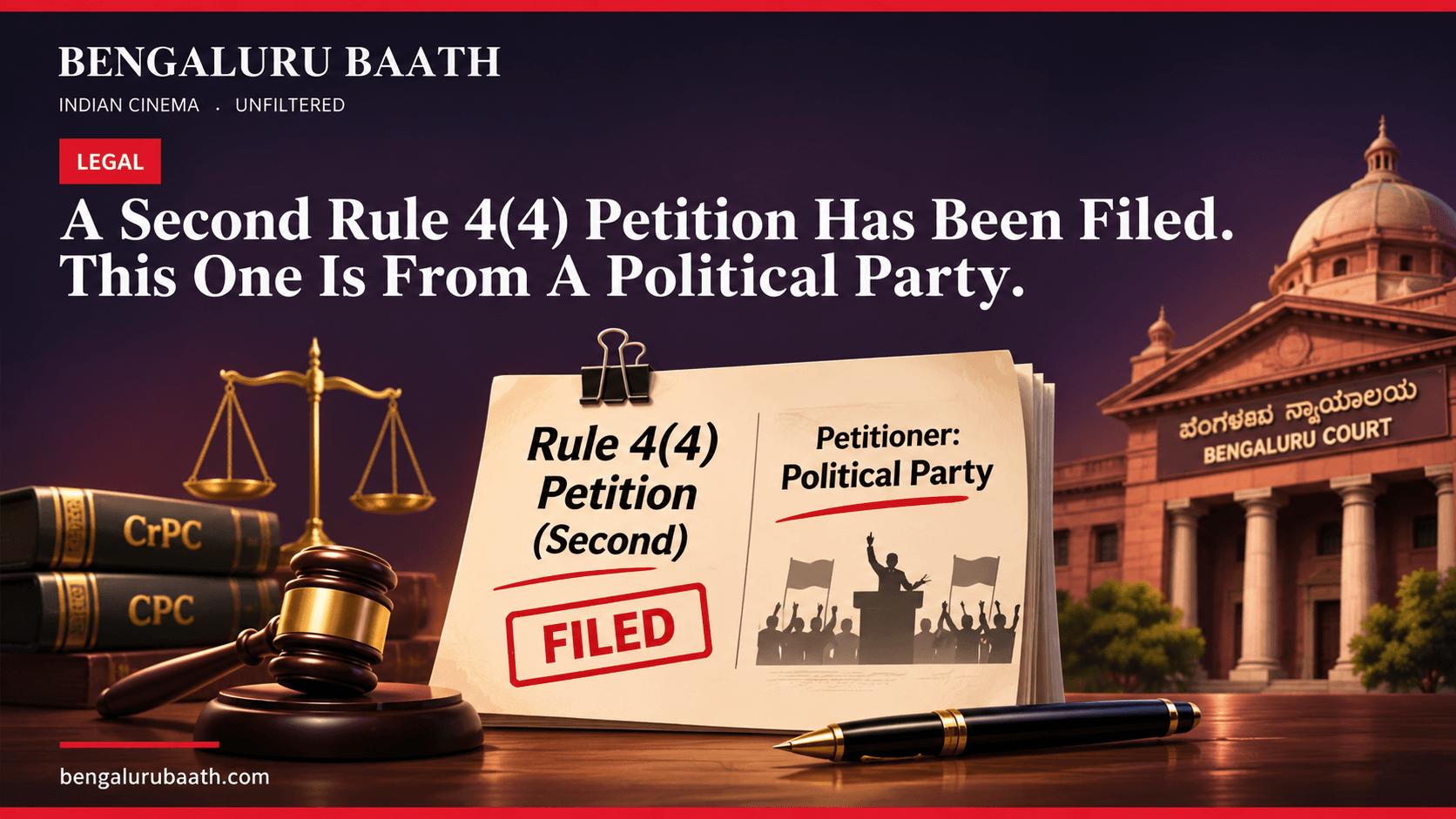
A second challenge to Rule 4(4) of the IT Rules has been filed in the Delhi High Court. This one comes from the Indian Youth Congress, through its national secretary Manu Jain, filed on 25 November 2026.
The respondents are the Ministry of Electronics and Information Technology, the Ministry of Home Affairs, and Meta. The petition seeks to strike down the part of Rule 4(4) covering previously blocked content, and to quash MeitY’s advisories of 8 and 10 October 2026.
Stage, stated plainly: filing only. No hearing, no notice, no bench and no case number has been reported. Nothing in this petition has been tested.
Why a second petition changes the shape
Because it attacks the same two advisories. The first challenge, which we covered when notice issued, goes after the same 8 and 10 October instruments.
Rule 4(4) is the provision that requires significant social media intermediaries to deploy automated tools to proactively identify content. The part under attack here is its application to material already the subject of a blocking order, which in practice means a permanent machine filter rather than a case-by-case takedown.
For film and performance that is the whole question. A matching system cannot read a carve-out. A judge can write that news, review, criticism, commentary, satire, parody, caricature and fan expression are protected, and no classifier applies it.
Four corrections to our own file
We got details of the first petition wrong and should fix them on the record.
- It is before a Division Bench, Acting Chief Justice Nitin Wasudeo Sambre and Justice Sanjay Sharma. We described it as being before a single judge.
- The petition is dated 4 November. 19 November, which we gave as the filing date, is the notice date.
- The next hearing is 18 January 2027, with similar matters listed 9 February 2027. We said only “January”.
- And the 2 November advisory we attributed to the CBFC is a Ministry of Information and Broadcasting document, File No. DM/40/2026-DM. More on that separately, but it is not the Board’s.
A Division Bench rather than a single judge matters: it raises the weight of whatever comes out of it and shortens the route to the Supreme Court.
What two petitions without a hearing until January means
It means the advisories operate for another two months whatever their merits. That is the ordinary arithmetic of Indian public law litigation and it is why the filing is rarely the story.
We have spent this month documenting what happens next. A competition case about distribution access was dismissed last week after nine years because nobody got it listed for admission. A cess matter was heard on 17 November and ten days later no outlet has published the order, while one half of an industry stays exempt and the other half pays.
Two petitions is not twice the pressure. It is two documents in the same queue.
What is not established
The case number, the bench, whether the two petitions will be heard together, and the text of either advisory, neither of which has been published in full by anybody we can reach. Meta has said nothing. Neither ministry has filed a reply on the record.
Bengaluru Baath Take
A political party’s youth wing has joined a legal challenge to automated content matching, which tells you the provision has stopped being a technology story and become a speech one. That is a meaningful shift in who thinks this is worth fighting.
But both petitions now sit behind a January date, and in the meantime the rule does what it does. The filings are reported and the orders are not, which is the condition of this entire beat.