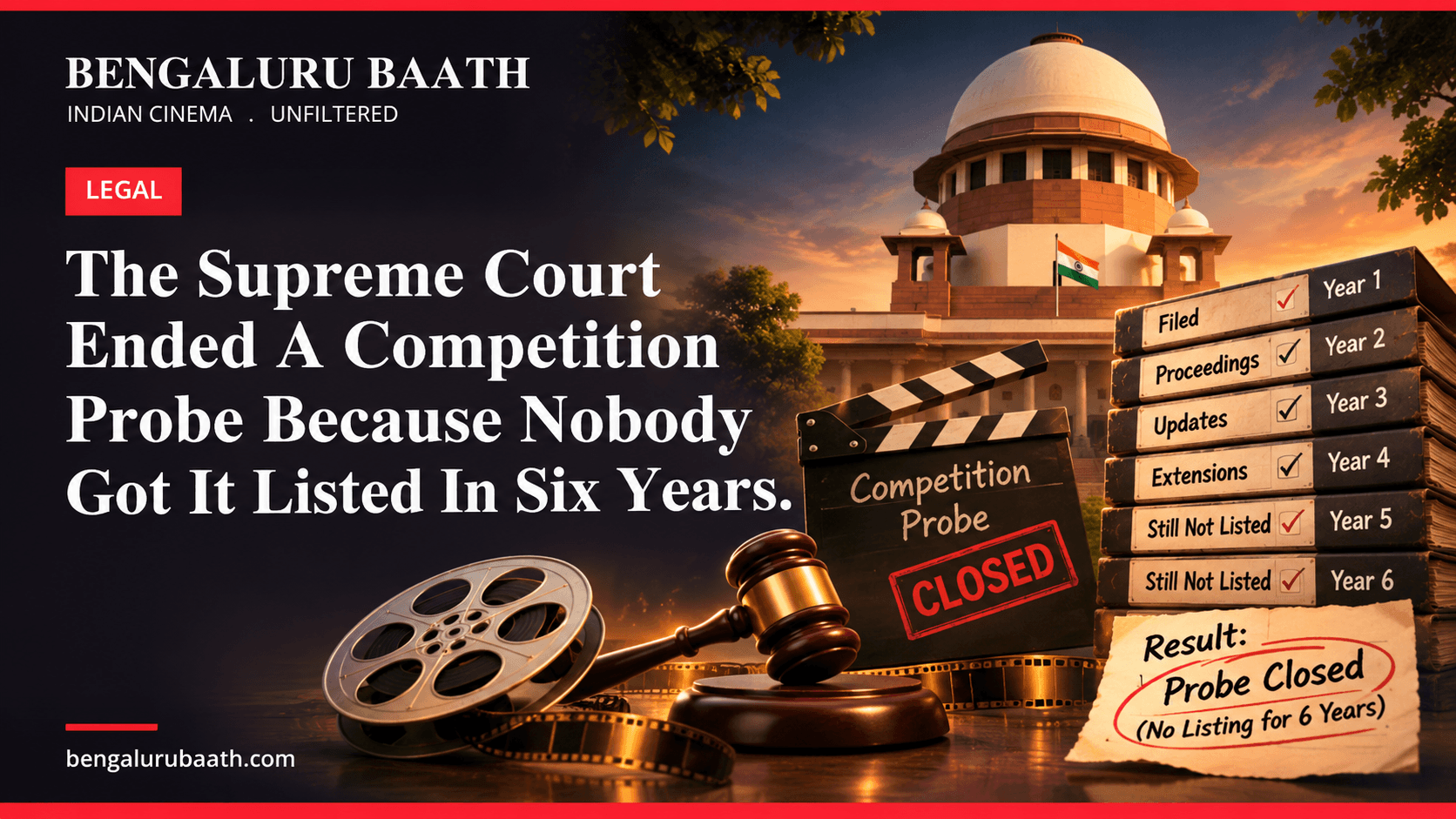
The Supreme Court has ended a competition investigation into two of India’s largest broadcasters without deciding a single question in it. The reason is that in six years, the regulator never got the case listed.
What happened on 20 November
Bench: Justices J.B. Pardiwala and K. Vinod Chandran. Case: Competition Commission of India v. Star India Private Limited, Diary No. 3222/2020.
From the order, as reported:
“It has been 6 years till this date, that the matter has not been even taken up for admission.”
“In view of the aforesaid, these petitions stand dismissed.”
And from the bench to the regulator: “What steps have you taken in the last six years to at least get it notified for the purpose of admission?”
Both sides appeared. For the CCI, Arjun Krishnan as advocate on record with Kaustav Som, Purushothaman R. and Garvish Jain. For the respondents, Senior Advocates Mukul Rohatgi, Maninder Singh and Neeraj Kishan Kaul, with Sonam Gupta and Sneha Jaisingh among others.
This is final as to the petitions and it is not a ruling on the merits. Nothing was held about the broadcasters’ conduct. The case was dismissed for inactivity.
What the dismissal leaves standing
A Bombay High Court order of 16 October 2019, which quashed the CCI’s orders of 27 and 31 July 2018 directing a Director General investigation. The High Court held the CCI had not recorded the required prima facie finding of an agreement involving refusal to deal, nor of an appreciable adverse effect on competition, and had not analysed the Section 19(3) factors.
The underlying complaint was filed on 7 June 2017 by Noida Software Technology Park Limited, a channel distributor, alleging discriminatory terms and the denial of non-discriminatory access to channels, under Sections 3 and 4 of the Competition Act.
Count the calendar. Complaint in 2017. Investigation ordered in 2018. Quashed in 2019. Appealed in 2020. Dismissed in 2026 for never having been listed. Nine years, and nobody ever examined whether the allegation was true.
Why a cinema desk is reporting a competition case
Because access to distribution is the plumbing under every broadcast and streaming deal in the country, and this was the only serious regulatory attempt to look at it.
Consider what else is live right now. The broadcasters are in the Karnataka High Court fighting an obligation to collect a 2 percent cinema cess, and winning interim protection while single screens pay. TRAI’s recommendations on licensing apps that distribute linear television have been sitting with the ministry since 26 October with no response. The Multiplex Association has objected to the Netflix and Warner Bros Discovery deal on the grounds that it threatens theatrical windows.
Every one of those is a question about who controls distribution and on what terms. The regulator’s one attempt to answer it in court has now expired of neglect.
And the pattern, which is becoming the story of this beat
We have spent two months documenting Indian film and media litigation that goes nowhere visible. A Bengaluru court bound Google, Meta and X in a film matter and the hearing listed for 6 November has still never been reported, nor has the court ever been named. A Rajasthan High Court matter that took a film off its release date was listed for 20 November and nobody has reported the outcome. A constitutional challenge to automated content blocking was filed this week and will not be heard until January.
This one is the end state of that pattern. A case can simply stop existing because nobody pushed it, and the only record of why is three paragraphs of a judge asking what the regulator has been doing.
Bengaluru Baath Take
A nine-year-old complaint about whether two broadcasters denied a distributor fair access has been disposed of without anyone establishing whether they did. The High Court said the regulator had not done its homework in 2018. The Supreme Court has now said the regulator did not do its homework on the appeal either.
Whatever the merits were, this is the regulator losing by default in the one forum where the question could have been settled. The broadcasters did not win the argument. Nobody had it.