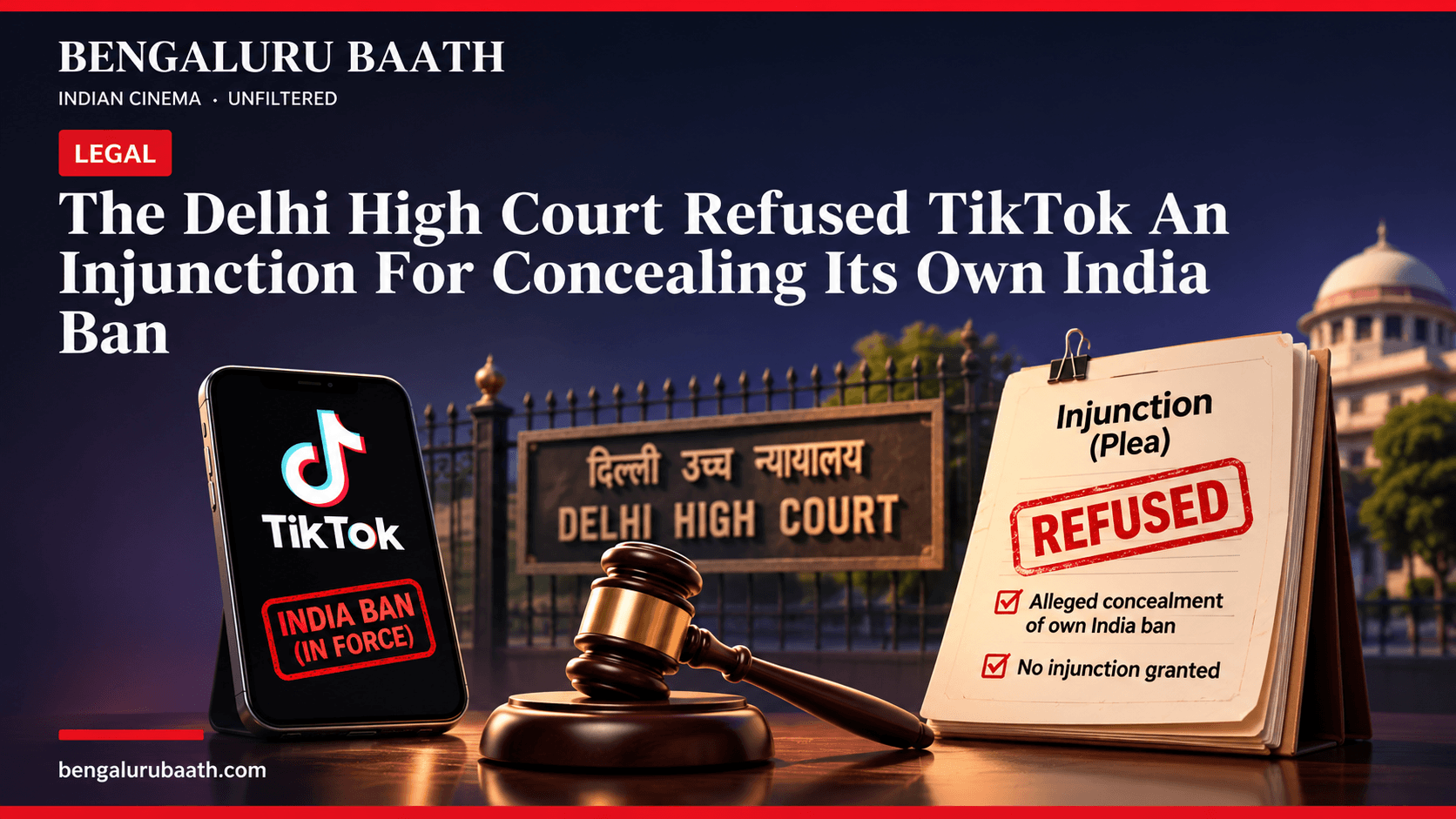
The Delhi High Court refused TikTok an injunction on 26 November because the company had not told the court about its own ban in India.
The case is TikTok Ltd v. Sandeep Singh, before Justice Purushaindra Kumar Kaurav. The court found that TikTok filed its 2024 suit without disclosing the June 2020 block on the app in India, made misleading claims about continuous use of the mark, and suppressed a Registry order of 31 October 2023 refusing it well-known mark status.
Relief was refused for want of clean hands. Separately, the defendant was restrained under Section 151 of the Code of Civil Procedure from relying on the disputed copyright registration, so neither side came away clean.
Why a cinema desk is reporting a trademark case
Two reasons, and the second is the important one.
First, this is how film titles and franchise names are actually protected in India. Continuous-use claims and well-known mark status are the instruments a studio uses to stop somebody else releasing a film with its franchise’s name. A judgment that refuses relief for non-disclosure sets the standard of candour a producer’s own application has to meet.
Second, and more consequentially: this is the same judge who wrote the Kriti Sanon personality-rights order. Justice Kaurav is the judge who refused an omnibus injunction on personality rights, held that the right belongs to every individual rather than flowing from fame, and carved out news, review, criticism, commentary, satire, parody, caricature and fan expression. That carve-out is the most film-relevant sentence written by an Indian court this year.
What this week’s order shows is a judge willing to refuse a global technology company the relief it asked for on grounds of candour. That is the same instinct, applied to a different litigant.
A correction to our own framing of personality rights
We have been writing that the scope of India’s personality right depends on which High Court you file in, contrasting Delhi with Bombay. That framing is wrong, or at least badly incomplete.
The documented divergence is inside the Delhi High Court, and the direction there is a narrowing of the right. Kriti Sanon, 29 October: no omnibus injunction. Janhvi Kapoor: relief on 552 of 6,884 URLs sought. A refusal in the CLAT topper matter. A caution on parody in the Alakh Pandey matter. A holding that the right is not inheritable, in the Sushant Singh Rajput matter.
On top of that, amici have been appointed in two suits, the December 2025 Salman Khan order is under challenge, and the Supreme Court has not settled any of it. So the live story is one court working out its own limits in public, not two courts contradicting each other.
The pattern this belongs to
Delhi is where this body of law is being made, and it is being made at a pace nobody is reporting. The challenge to automated content matching is before a Division Bench of the same court and will not be heard until January.
Meanwhile the matters that go unreported are the ones that end. A competition case about distribution access was dismissed after nine years because nobody got it listed. A film that lost its release date to a court order is still waiting for anybody to publish what happened next.
What is not established
The case number. Whether TikTok will appeal. What the underlying dispute between the parties actually concerns beyond the mark and the copyright registration. And the full text of the order, which we have not read.
Bengaluru Baath Take
A court refused a company an injunction because it had not mentioned that its product is banned in the country where it was seeking protection. That is a straightforward application of a very old principle and it is a useful reminder that candour is a condition of relief, not a courtesy.
The more interesting thing is the judge. The same bench that is quietly narrowing personality rights in India is also the one holding a global platform to the disclosure standard. Delhi is writing the rules for both, and almost nobody covering cinema is reading them.