Indian cinema produces a lot of films that a lot of people watch. It has produced exactly one filmmaker whose work is a standard reference point for directors who have never seen another Indian film.
How Satyajit Ray Made Pather Panchali
Pather Panchali released in 1955, directed by Satyajit Ray. It was his first feature, made without formal film training, and its production was famously protracted and underfunded, completed with support from the West Bengal government.
The film became the first part of what is now known as the Apu Trilogy, alongside Aparajito and Apur Sansar.
Ray’s international standing is not a matter of Indian assertion. The Hollywood Reporter published a feature on how Wes Anderson’s aesthetic was shaped by Ray, and Anderson has been explicit about the debt. The Golden Globes’ own archive piece on the film documents its standing in the Western canon.
Britannica’s entry on Ray records a career that extends well beyond the trilogy across four decades of filmmaking, fiction writing, illustration and composing.
The Background
Ray came to filmmaking from advertising and book illustration in Kolkata. He had designed the covers for a Bengali edition of the Bibhutibhushan Bandyopadhyay novel that became Pather Panchali, which is how he came to the material.
The decisive influence was seeing Vittorio De Sica’s Bicycle Thieves in London, and the neorealist approach to shooting on location with non-professional actors is directly visible in the resulting film.
Indian cinema in 1955 was overwhelmingly a studio-based industry built around song, spectacle and star performance. Pather Panchali was something structurally different: shot on location, largely with non-actors, built on observation rather than plot.
That it emerged in Bengal is not incidental. Kolkata’s literary and intellectual culture produced both the source novel and the audience that made the film possible.
What We Know
Established: Pather Panchali released in 1955 as Satyajit Ray’s debut feature; Ray had no formal film training; the production was extended and underfunded; it forms the first part of the Apu Trilogy; Ray’s influence on international filmmakers including Wes Anderson is publicly documented; Ray’s career spanned four decades and multiple disciplines.
Analysis, labelled: assessments of the film’s specific formal influence and of Bengal’s cultural role in producing it are interpretive.
Why It Matters
The practical point for anyone making films in India today is that Ray’s work represents a route that Indian cinema has mostly not taken and periodically rediscovers.
It is also the strongest available rebuttal to a recurring anxiety in Indian film culture, which is the assumption that international recognition requires international packaging. Ray’s films are entirely local in setting, language and texture, and they travelled further than anything Indian cinema has produced since.
For Bengali cinema specifically, Ray is both the industry’s greatest asset and a difficult inheritance. A film culture defined by a towering figure can struggle to be discussed on its own current terms.
And for film preservation, the Apu Trilogy’s restoration, which required reconstructing damaged negatives, is a reminder of how close India came to losing its most important films.
The Bigger Picture
Ray is frequently invoked and less frequently watched, which does his work a disservice. The films are not difficult or austere in the way their reputation suggests. They are funny, observant and often extremely moving, and the pacing that reads as slow in summary does not feel slow while watching.
He also worked in a much wider range than the art-house reputation suggests, including detective fiction, children’s fantasy and science fiction writing.
The most useful thing anyone can do with the seventieth anniversary of his debut is not write about him. It is watch the films.
Bengaluru Baath Take
There is a particular Indian habit of treating Ray as homework, which is exactly backwards. These are films about a family that does not have enough money, a boy who wants to see a train, and a grandmother nobody has time for, and they are as immediately gripping as anything you will watch this year. The reason directors around the world keep citing him is not that he was important. It is that he was good, in a way that does not age. Stop citing him. Watch Pather Panchali on a decent screen and then tell us Indian cinema needs to package itself for anybody.
More On Bengaluru Baath
- The Industry That Gave India Satyajit Ray Is Now Fighting To Stay Relevant
- Indian Cinema Started With A Man Who Mortgaged His Life Insurance
Sources
- The Hollywood Reporter
Wes Anderson on how Satyajit Ray shaped his aesthetic, documenting Ray’s international influence. - Britannica
Reference-standard biography of Ray’s career across four decades and multiple disciplines. - Golden Globes
Archive feature on Pather Panchali and its standing. - Wikipedia: Pather Panchali
Production history, funding, credits and the Apu Trilogy context.
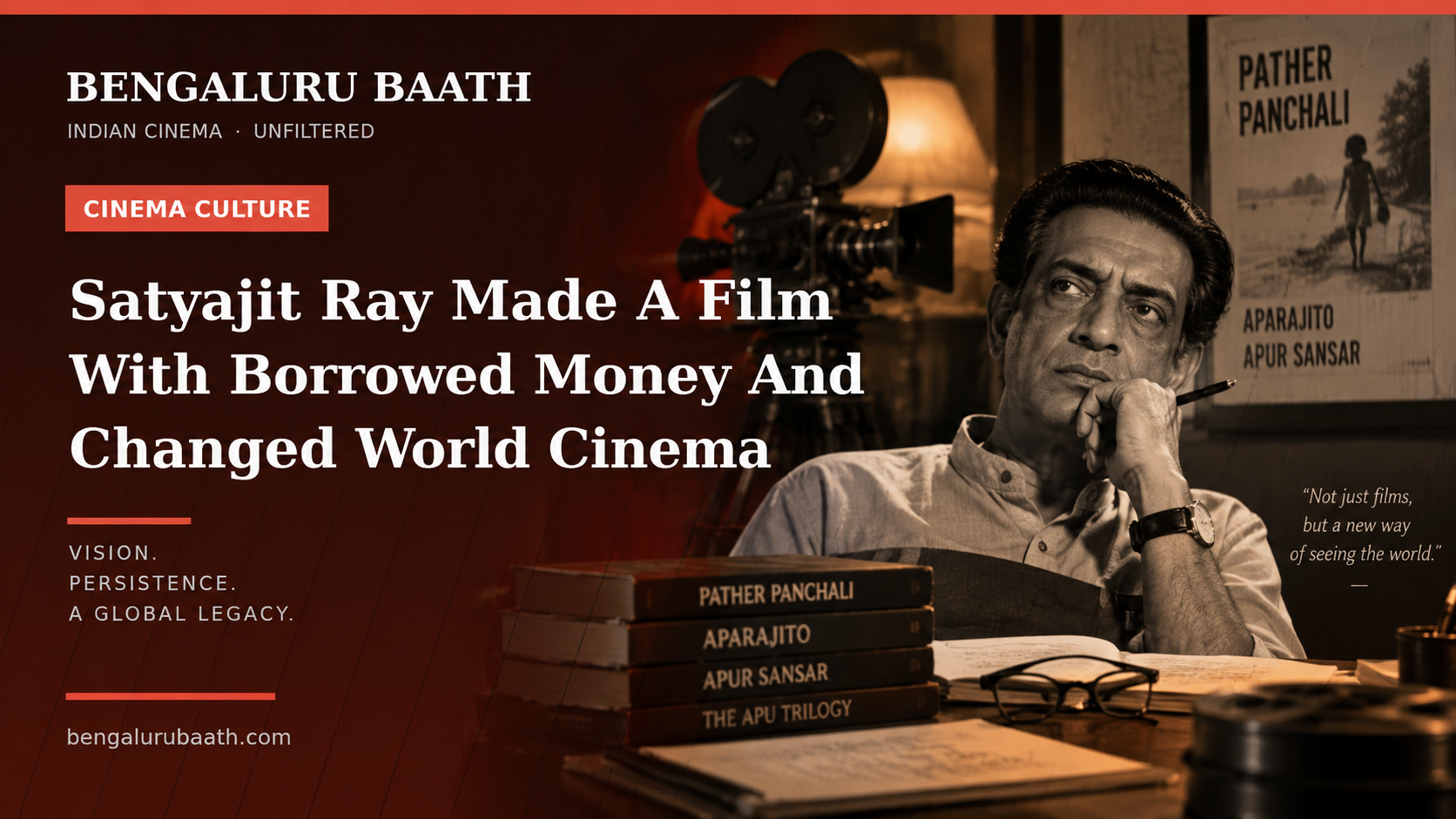
Image: original illustration by Bengaluru Baath, not a photograph.