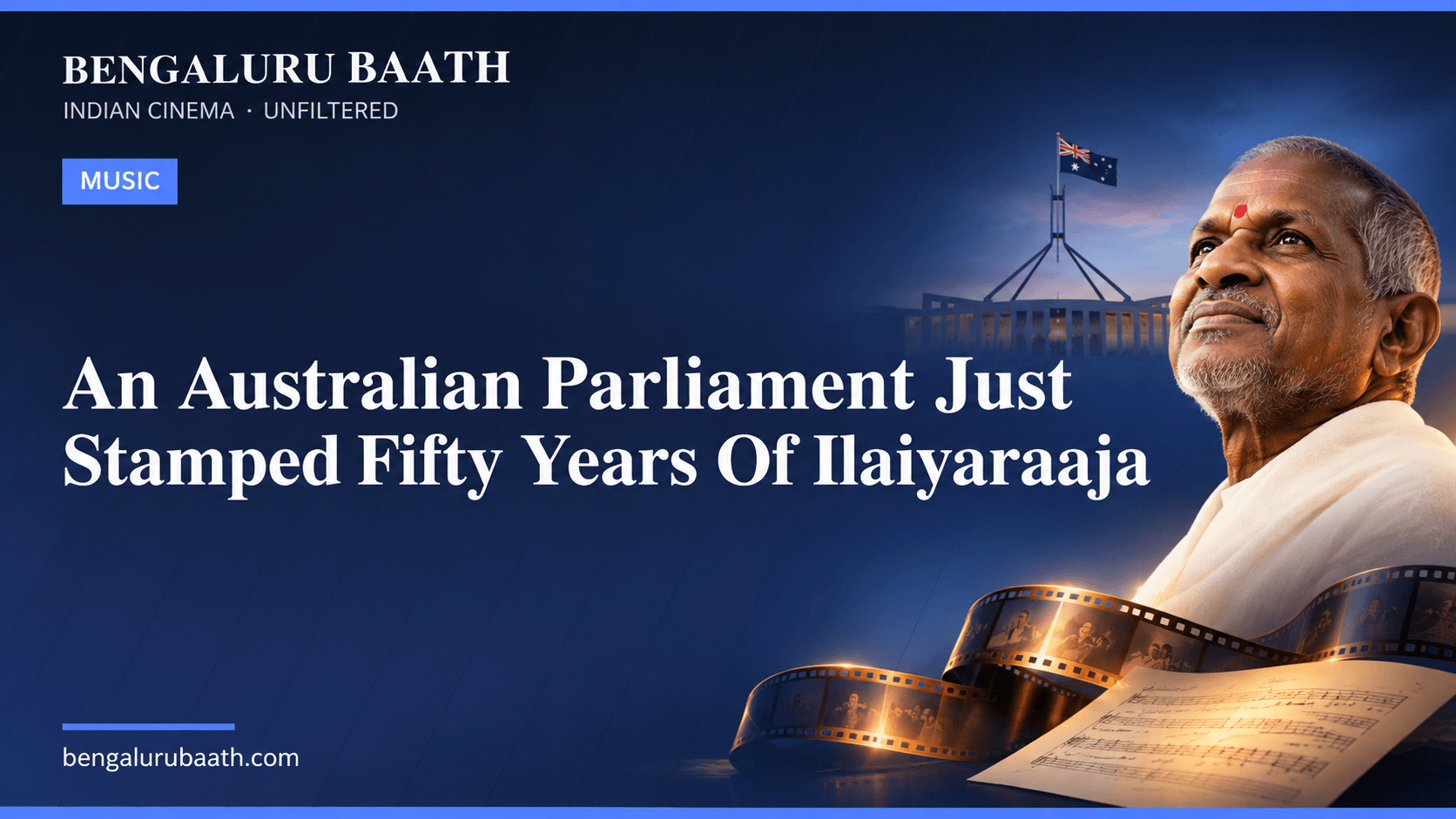
The Parliament of Victoria, in Australia, has released a ceremonial stamp marking fifty years of Ilaiyaraaja in cinema. The honour was presented by Enver Erdogan MP, Minister for Finance in the Victorian Government, alongside other members of parliament.
Ilaiyaraaja’s response, quoted by DT Next, was this: “Being born in a small village in Tamil Nadu and being honoured in the Australian Parliament is a truly moving experience.”
That is the whole story in one sentence, and he wrote it better than anyone covering it has.
What The Fifty Years Actually Covers
The clock starts in 1976 with Annakkili, the film that introduced a composer who had not yet decided that Tamil film music needed rebuilding from the ground up.
Since then: music for more than 1,500 films across multiple languages. Reported by The Hollywood Reporter India, Filmibeat and Deccan Chronicle.
Fifteen hundred is a number that stops meaning anything when you read it, so try it this way. If he had composed for one film every single week without a break, he would have needed nearly thirty years to reach that figure. He has scored more films than most working composers will watch.
Why It Was Not Just Volume
The reason Ilaiyaraaja matters is not the count. It is what he did to the sound.
Before him, Tamil film music had its own strong traditions but a fairly settled relationship with Carnatic structure and folk forms on one side and Hindi film orchestration on the other. He came in with rural Tamil folk in one hand and Western classical counterpoint in the other and refused to treat them as separate categories.
The result is the thing every Tamil listener recognises instantly without being able to name: a village melody carried by a string section that is doing genuine harmonic work underneath it rather than just swelling on cue. He wrote for orchestras the way a composer writes for orchestras, in a film industry where the norm was to write a tune and let an arranger deal with the rest.
He also worked at a speed that has never been properly explained and probably never will be.
The Australian Part Is Not Random
It is easy to read a Victorian Parliament stamp as a diaspora courtesy, and that reading is lazy.
Victoria has one of the largest Tamil populations in Australia, concentrated in and around Melbourne, built up across several waves of migration including the Sri Lankan Tamil arrivals of the 1980s and 1990s and the Indian student and skilled-migration intake since. For a very large number of those families, Ilaiyaraaja’s catalogue is not nostalgia. It is the sound of the house.
A parliament issuing a ceremonial stamp for a film composer is a piece of constituency recognition, and it is also an acknowledgement that a body of work made in Tamil, in Tamil Nadu, for a Tamil audience, ended up being load-bearing cultural infrastructure on the other side of the Indian Ocean.
The Honours Have Started Arriving Late
There is a pattern worth noticing across Indian cinema this month. Anant Nag received the Dadasaheb Phalke this week, thirty years after the only other Kannada actor to get it. Andhra Pradesh has just cleared fourteen years of unheld Nandi Awards. And Ilaiyaraaja’s fifty-year mark is being commemorated by a legislature in Melbourne.
The Indian honours system has a consistent habit of arriving after the work is finished and, quite often, after everybody else has already noticed. Ilaiyaraaja has received major national recognition at home, so this is not a case of neglect. But there is something slightly pointed about a ceremonial stamp for an Indian composer being issued by an Australian state parliament, and it is worth sitting with rather than glossing over.
The Number That Should Be Bigger
Here is a practical complaint with the celebration. A catalogue of 1,500 films is one of the largest bodies of recorded music by a single composer anywhere in the world, and its availability is patchy, its rights position is complicated, and a meaningful part of it exists in poor-quality transfers or not at all in digital form.
Stamps are lovely. A properly funded, properly licensed, properly mastered archive of the Ilaiyaraaja catalogue would be the actual monument, and nobody has built one.
Bengaluru Baath Take
“Being born in a small village in Tamil Nadu and being honoured in the Australian Parliament” is the line, and it works because he is not being modest. He is describing a distance. Most people who cover this kind of ceremony reach for the word humbled. He reached for geography, which is more precise and considerably more moving.
Fifty years, fifteen hundred films, and the single most recognisable orchestral signature in Indian cinema. The stamp is a nice gesture from a parliament that did not have to make it.
Now somebody fund the archive.
More On Bengaluru Baath
- A Marathi Folk Musical Just Beat Dhurandhar To The Oscars. Yes, Really
- Anant Nag Took The Phalke And Handed The Credit To Karnataka
Sources
- DT Next, ceremony details, presenter and Ilaiyaraaja’s statement
- The Hollywood Reporter India, stamp and fifty-year milestone
- Filmibeat, career figures
- Deccan Chronicle, honour coverage