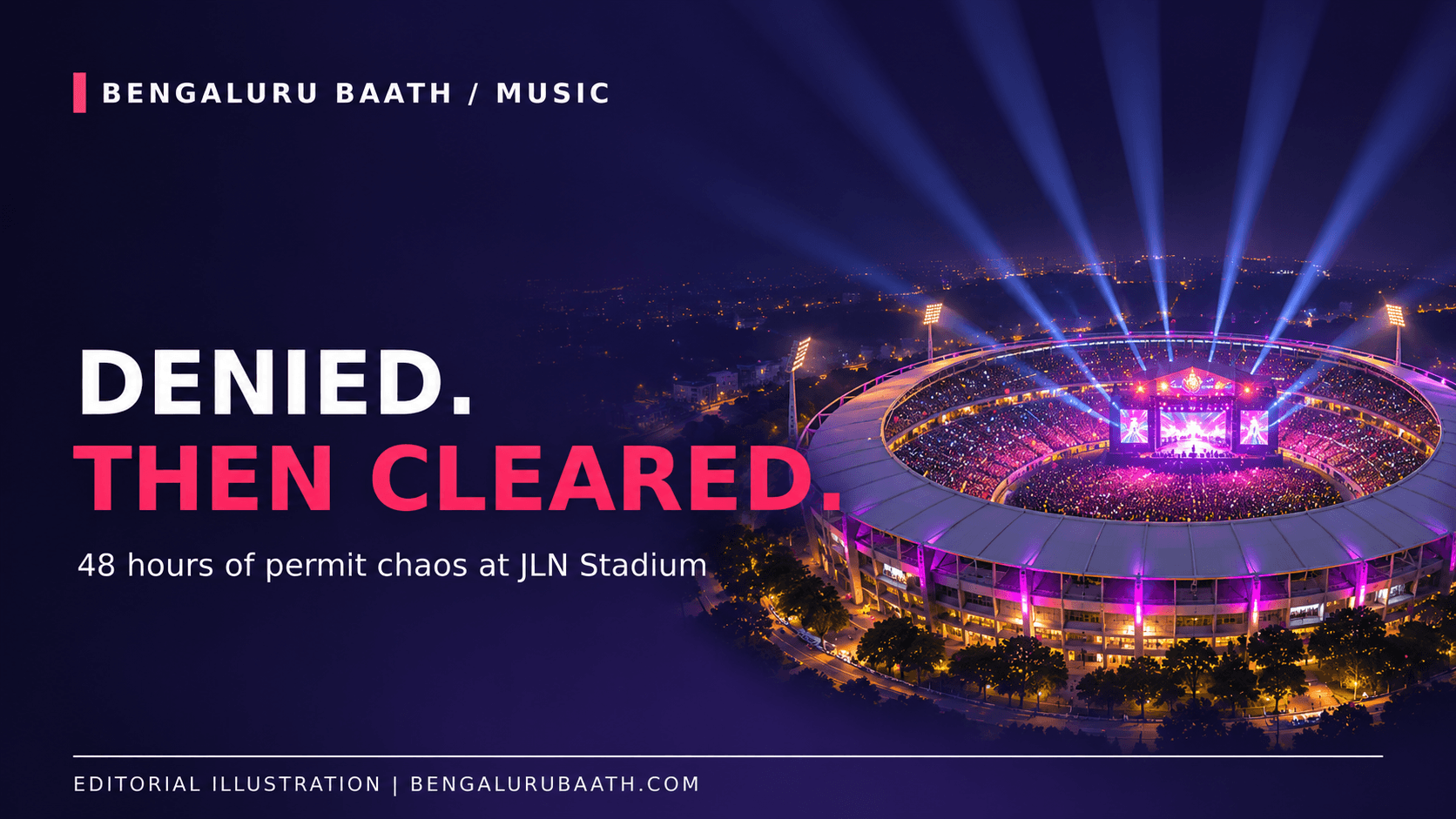
For about 48 hours in October, the opening night of the biggest Indian concert tour of the year did not have a permit.
Diljit Dosanjh’s Aura India Tour was set to begin at Delhi’s Jawaharlal Nehru Stadium on 30 October 2026. On 21 October, the Delhi Police said no. By 23 October, after a round of meetings and a fresh security plan, they said yes. In between, a lot of fans were told the show was cancelled when it was not.
Here is how it played out, and why it matters for every big gig in India.
The Letter
According to Outlook, Siasat carrying IANS and Time Out Delhi, the Office of the DCP, South District, wrote to the organiser BookMyShow Live on 21 October denying permission for the event. The reasons cited were “specific threat related inputs” and the pressures of the festive season.
The letter’s key line, as quoted by Outlook, was: “the same cannot be acceded to.”
Police language does not get more final than that. Unsurprisingly, the internet decided the show was dead.
The “Cancelled” Scare
Some reports went a step further and claimed the concert had been cancelled outright, with refunds on the way. That turned out to be wrong.
BookMyShow Live told IANS that permission had been “temporarily withheld” and that the concert was not cancelled, per Siasat. The organiser’s statement, as carried by Siasat, was carefully diplomatic: “We, with Delhi Police, are committed to ensuring a good experience for attendees as well as local commuters.”
That second half, “local commuters”, is doing a lot of work. Anyone who has tried to get anywhere near Lodhi Road on a big event night knows exactly why traffic sits next to security in every permit conversation.
The U Turn
On 23 October, after the organisers presented a detailed safety, traffic and crowd management plan, the police reconsidered and granted permission, according to Outlook, Siasat and Oneindia, citing ANI.
Delhi Police officials told ANI, as quoted by Oneindia: “They had multiple meetings, in which the organisers presented detailed plans regarding security concerns.”
So the story is not “Delhi Police versus Diljit.” It is the more boring and more important one: a permission system that runs on last minute paperwork and meetings, with a stadium full of ticket holders waiting on the outcome.
The Rest Of The Tour
With Delhi cleared, the India leg runs on to more cities. Per Time Out, the remaining dates are:
- 15 November: Indore
- 21 November: Ahmedabad
- 27 November: Mumbai
- 29 November: Bengaluru
- 5 December: Lucknow
- 19 December: Kolkata
- Chandigarh: date to be announced at the time of writing (since reported as 12 December)
Yes, Bengaluru, that is you on 29 November. Start planning your route to the venue now.
The Bigger Problem: India’s Permit Lottery
This was not a one off. 2026 has been a rough year for concert permissions.
Variety India reported in April that Mumbai went through a crackdown after overdose deaths at an event at NESCO on 11 April. It said the required permissions for Circoloco were not granted, French Montana’s Boombox show was cancelled, and Maharashtra proposed a single window clearance system with a 25 member SOP panel. A Ye show in Delhi was also halted over security concerns in May.
And in September, at FICCI FRAMES, the government said a single window portal for event permissions was operational and that states were being asked to follow a 15 day deadline, as we reported from that session. The Diljit episode shows the gap between that policy and what actually happens on the ground. A denial letter nine days before the show, a reversal seven days before. That is not a 15 day process. That is a scramble.
For fans, the cost is anxiety and fake refund rumours. For promoters, it is worse: production crews, artist schedules, sponsors and hotel blocks are all committed long before police make a final call. For brands buying into concert sponsorships, which is now a serious marketing line item in India, this is the risk nobody puts on the rate card.
Update, 31 October: The Show Went Ahead
The opener happened on 30 October and was described as sold out, though no attendance figure was given, according to DT Next, carrying PTI. The production included a light show, a moon backdrop, fireworks and a drone finale, and Republic reported that the drones spelled out “Panjabi Aa Gaye Oye!”. The two outlets disagree on the opening song: PTI says “Kehnde Soniye”, Republic says “Morni”.
Diljit addressed the permit drama directly from the stage. “It was our first show. There were a lot of attempts made to stop me,” he said, per PTI. He also thanked the CRPF personnel on stage: “If you are not here, we can’t feel safe.”
BookMyShow’s Naman Pugalia, CBO Live Events, told Republic: “Delhi didn’t just open the RuPay AURA India Tour; it set the bar for every city that will follow.”
PTI’s updated schedule now lists Chandigarh on 12 December, and says Diljit will be in India until 20 December. Separately, in an Instagram Live after the show, he said a planned Bihar concert had fallen through because he was asked to take responsibility for crowd management, as Outlook reported: “They asked if we would take responsibility for it.” That is the permit problem again, from the other side.
Bengaluru Baath Take
India’s biggest touring artist almost lost his opening night to a two paragraph letter, and got it back after a few meetings. If Diljit can be stuck in permit limbo, every smaller act playing a 5,000 capacity ground has no chance of predictability. The solution is not more goodwill meetings at the eleventh hour. It is a clear, published, time bound process that actually works. Until then, every concert ticket in India comes with an invisible asterisk.
Sources
- Outlook: Diljit Dosanjh’s October 30 Delhi concert gets police approval
- Siasat (IANS): Diljit Dosanjh’s Delhi concert not cancelled, gets police nod
- Oneindia (ANI): Diljit Dosanjh Delhi concert gets permission after meetings
- Time Out Delhi: Diljit Dosanjh’s Aura India Tour in Delhi hits hurdle
- Variety India: Is India going through a concert crisis?
- DT Next (PTI): Diljit Dosanjh puts up grand show in Delhi
- Republic: Diljit Dosanjh delights fans, thanks Delhi Police and CRPF
- Outlook: Diljit Dosanjh wanted to perform in Bihar