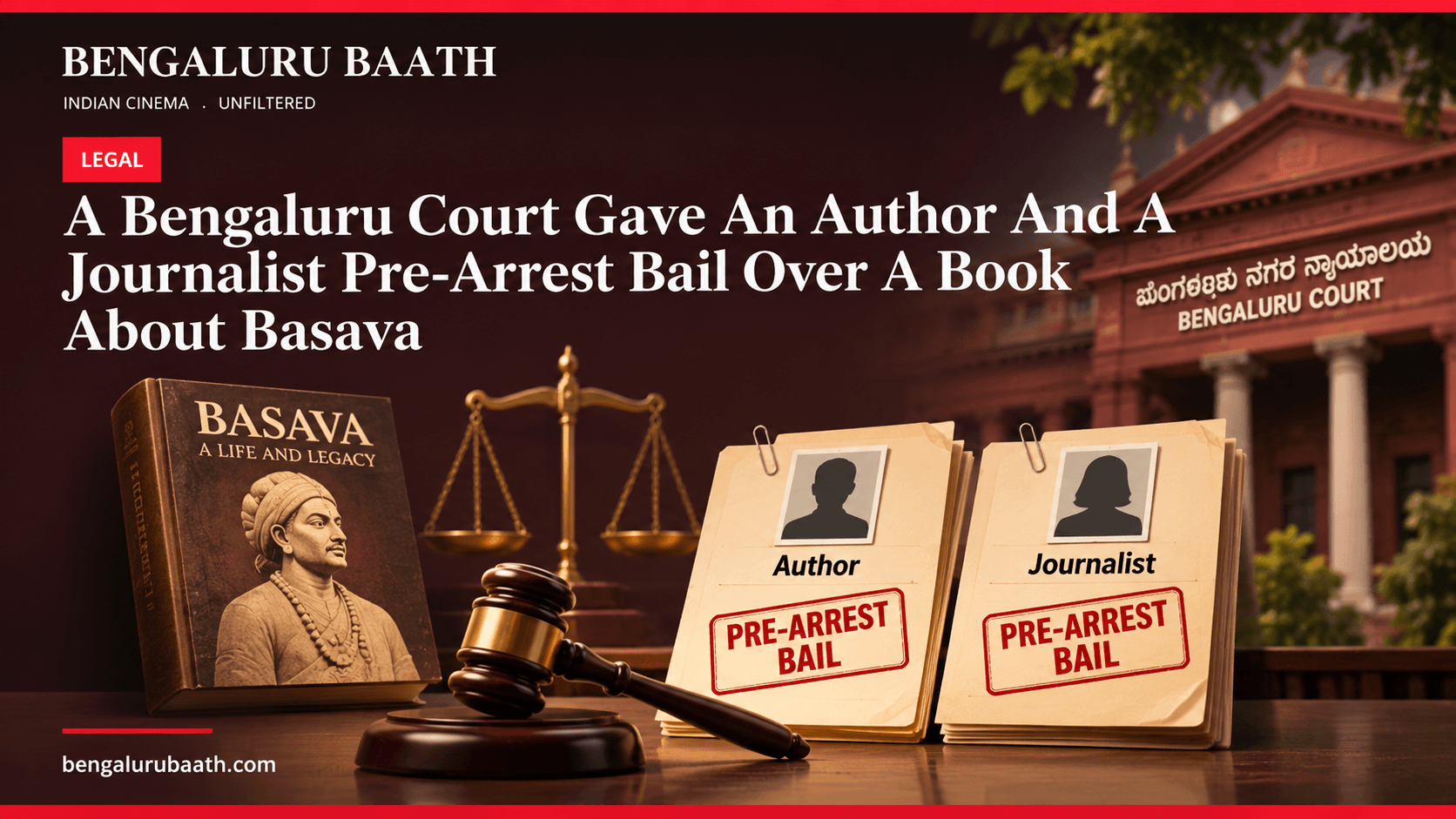
A Bengaluru sessions court granted pre-arrest bail on 25 November to the author Ravi Hanjagimutt and the journalist Vishweshwar Bhat over a book about Basava. The matters are Crl.Misc./0011453/2026 and Crl.Misc./0011451/2026.
What this is and is not: bail, and nothing else. There has been no trial, no charge framed, and no finding by any court on whether either man did anything wrong. The allegations remain allegations.
The complaint
The FIR was registered by High Grounds police station on a complaint by Aravind Jatti, concerning the book Basava Mantapa. The sections invoked are BNS 192, 196(1), 353(2) and 299.
Section 299 is the provision on deliberately wounding religious feelings. Section 196(1) covers promoting enmity between groups. Section 353(2) deals with statements conducing to public mischief. These are the speech provisions, not the property or violence ones.
Hanjagimutt was separately detained at Cochin airport on a Look Out Circular. His petition in the Karnataka High Court to quash the FIR has not been heard.
Why a cinema desk is reporting a book case
Because BNS 299 is the same provision that governs what a film may depict, and because the pipeline from a complaint to a blocked release runs through exactly these sections.
A film adapting a text about Basava, or any religious or caste history, faces this clause at three separate gates: certification, a writ petition, and a police complaint after release. The case law and the practice built around books is what a producer inherits.
And look at the week’s other speech matters. A constitutional challenge to automated content blocking is pending in the Delhi High Court and will not be heard until the new year. The certification record that would let anybody check what a film was actually required to change is behind a 403. This case is the offline end of the same machinery.
The Karnataka pattern, which is now hard to ignore
Three film and media matters in this state are live and only one of them has a visible record. The cinema cess was heard on 17 November and ten days later nobody has published the order, while broadcasters hold interim protection and single screens pay. A John Doe order in a film defamation matter bound Google, Meta and X, and the court, the judge and the case number have never been published by anybody.
This one we have, with case numbers, because a sessions court bail order is reported. The High Court quashing petition that would actually settle it is not listed anywhere we can see, and the Karnataka High Court’s own domains are unreachable and the eCourts portal is captcha-gated, so we cannot check the cause list ourselves. That is press silence rather than judicial silence, and we say which it is.
What we are not publishing
The contents of the complaint, which we have not seen. What the book says about Basava, which we have not read and which is in any case not the question before the court. Any characterisation of the complainant’s motives. And any suggestion that bail implies either guilt or innocence, because it implies neither.
Bengaluru Baath Take
An author and a journalist needed a court’s protection from arrest over a book, and the provisions used are the same ones a filmmaker meets at the certification counter. That is the connection worth holding on to: India’s speech law does not distinguish much between a page and a frame, so what happens to writers arrives at cinema a year or two later.
The quashing petition is where this gets decided, and it is not listed anywhere the public can see. As with the cess, the document that matters is the one nobody can read.