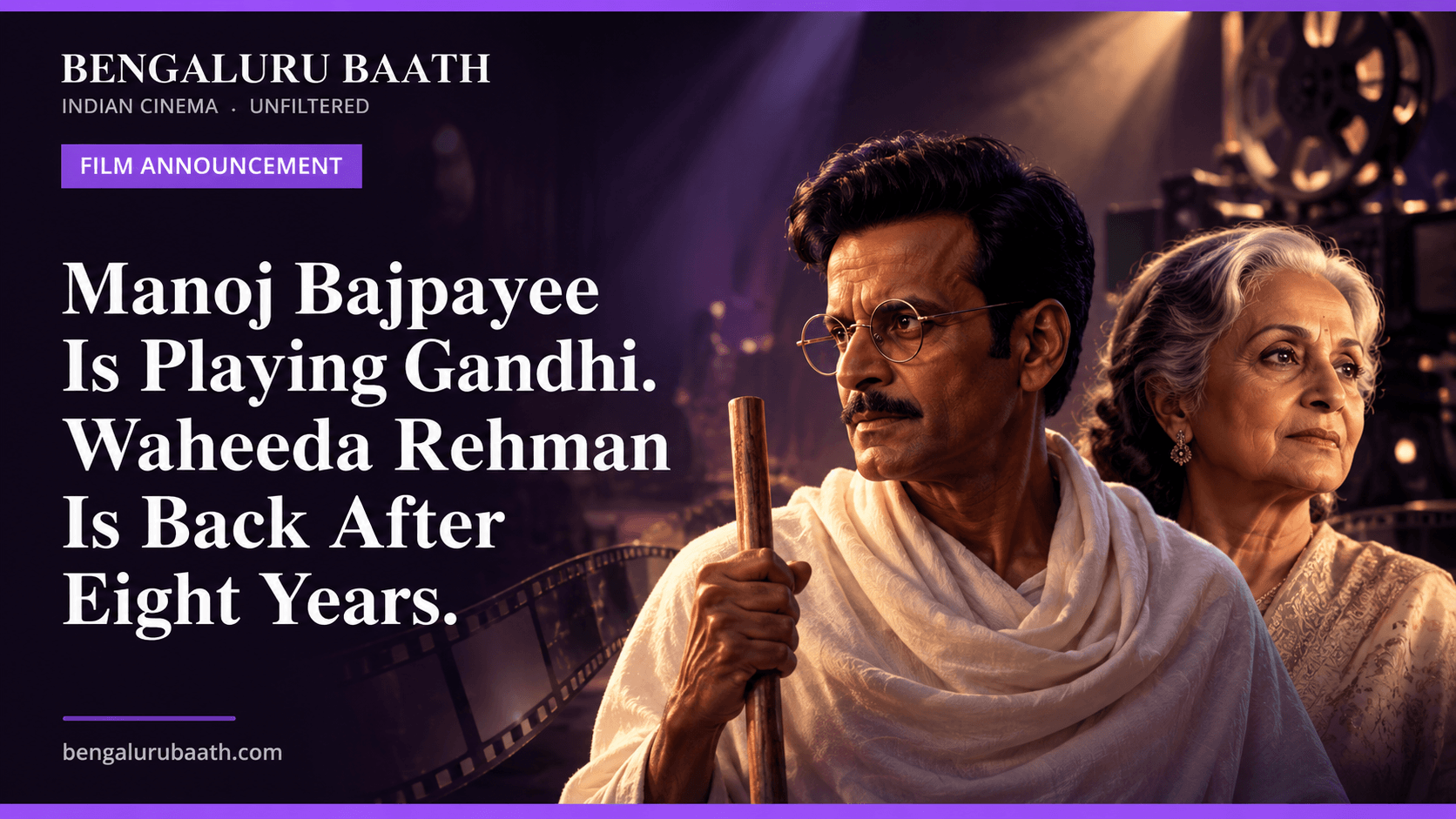
Manoj Bajpayee is playing Mahatma Gandhi in a film directed by Sudhir Mishra, and Waheeda Rehman is in it, back on screen after about eight years away. That second detail is the one that should make you sit up.
The project surfaced on 3 October, the day after Gandhi Jayanti, through producer Anubhav Sinha. Bollywood Hungama and CineBuster both carry the same details. Saurabh Shukla is in the cast. Sinha’s Benaras Media Works is producing with Narendra Hirawat, presented by NH Studioz. No title and no release date yet.
The subject is the interesting part. Rather than a life story, the film covers a 21-day stretch around independence when Gandhi withdrew from the centre of power in Delhi. A man walking away from the exact moment he spent forty years working towards, and what that cost, told across three weeks.
The quote, and the argument against it
Sinha also said this, on the record: “I believe there should be one or two films made on Gandhi every year for the next 100 years. It is our responsibility as filmmakers to keep bringing the stories of our freedom fighters to audiences.”
The case for that position is real and we will make it properly. India’s freedom struggle is within living memory for a shrinking number of people, the school syllabus treats it as dates to be memorised, and cinema is the one medium that still reaches people who will never open a history book. If a generation’s entire encounter with Gandhi is a statue and a holiday, filmmakers who can do better and do not are making a choice. Richard Attenborough’s film did more for global understanding of the man than any number of monographs. That argument stands up.
Here is the argument against it. One or two films a year for a hundred years is a production quota, and quotas produce hagiography. The Indian biopic economy already runs on reverence as a risk-management strategy: the safest film about a national figure is the one that praises him, because praise is the version nobody objects to, nobody petitions against and nobody needs a clearance for. Two hundred commemorative Gandhi films would not teach anyone anything about Gandhi. They would teach people that Gandhi is a subject on which only one tone is permitted.
And the film Sinha is actually making is the counter-argument to his own sentence. Twenty-one days of a man leaving the room is not an annual commemoration. It is a specific, awkward, interior choice that most producers would have talked a director out of. He is defending the project in the language of national duty while financing something considerably braver than that.
Why this lands the week it lands
Two days ago we wrote about a film that received an Information and Broadcasting Ministry no-objection certificate for a version reportedly described as heavily altered, now talking about India and China “in a positive light”. So this is the week in which Indian cinema both announced a Gandhi film about withdrawal from power and confirmed that a film about a border clash was reshaped upstream of the censor board.
Those two stories are the same story. In both cases the question is not whether films about the nation get made. They get made constantly. The question is which version gets to exist. A Gandhi film can be a hundred-film annual observance or it can be twenty-one difficult days, and the deciding factor is almost never the director.
Waheeda Rehman
Do not let this get buried under the Gandhi discussion. Waheeda Rehman is in her late eighties and has barely worked in close to a decade. Whatever the role is, somebody wrote a part worth her coming back for, which is rarer in Hindi cinema than any box office record reported this week. She has one of the great filmographies in Indian cinema and the industry’s standard offer to actors of her generation is a grandmother in two scenes.
Pair her with Bajpayee, an actor who has spent his career refusing to play anybody as an icon, and Mishra, who has never made a flattering film about anything, and the casting is doing more to tell you what this film is than the press note is.
Bengaluru Baath Take
Yes to this film. No to the quota.
The thing standing between Indian audiences and a good film about Gandhi is not a shortage of Gandhi films. It is that a film which shows him as difficult, wrong about things, politically outmanoeuvred and personally costly to the people around him is a film somebody will want altered before release, and everybody in the chain knows it. That is a clearance problem and a nerve problem, not a volume problem.
Sinha has put Bajpayee, Shukla and Waheeda Rehman in front of Sudhir Mishra and pointed them at three weeks in 1947 when the most famous man in the country decided the room was not worth being in. If that film survives to release in the shape it was written, it will be worth more than the next ninety-nine commemorative ones. We will be watching what shape it arrives in.