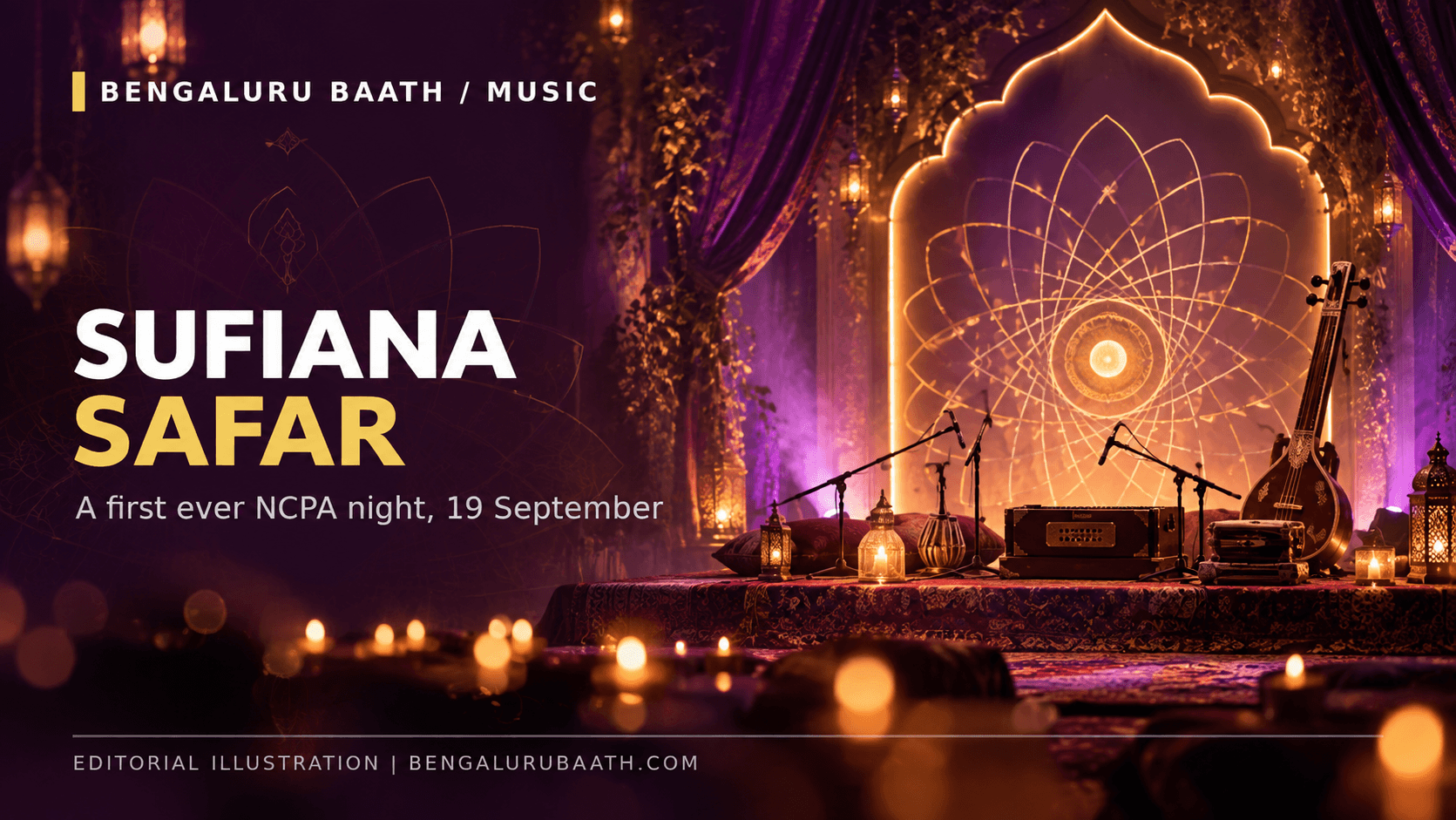
Here is a sentence that sounds fake but is not: until last Saturday, AR Rahman had never performed at the NCPA.
The man has two Oscars, Grammys, a catalogue that basically rewired Indian film music, and concerts everywhere from Wembley Arena to Kuala Lumpur. And yet the National Centre for the Performing Arts in Mumbai, arguably the country’s most prestigious performance address, was still on his to do list. On 19 September 2026, he ticked it off with Sufiana Safar at the Jamshed Bhabha Theatre.
What The Show Was
This was not a “hits medley with confetti cannons” night. The NCPA’s own event page billed it as an evening rooted in Sufi ideology, with Rahman exploring traditional repertoire such as “Man Kunto Maula” and “Dama Dum Mast Qalandar,” compositions associated with Nusrat Fateh Ali Khan and Munna Shaokath, and his own film pieces including “Kun Faya Kun” from Rockstar and “Khwaja Mere Khwaja” from Jodhaa Akbar.
The NCPA described it as “a rare concert with Rahman taking the stage to present a bouquet of Sufiana compositions,” with the intent of “creating a seamless dialogue between tradition and innovation.”
According to the Bandsintown listing, Rahman was backed by an ensemble from his own KM Music Conservatory. Radio and Music reported that percussionist Sivamani was part of the lineup, and that the NCPA described the theatre as packed.
The Numbers
- Date: 19 September 2026, 6:30 pm
- Venue: Jamshed Bhabha Theatre, NCPA, Mumbai
- Member ticket tiers: Rs 13,500, 12,150, 9,900, 8,100, 5,850, 3,600 and 1,800, inclusive of GST, per the NCPA listing
- Non member entry: from Rs 2,000, per Time Out Mumbai
- Age limit: 6+
That ticket spread is its own little story. The top tier is premium concert money, while the entry tier is roughly a multiplex weekend. NCPA shows tend to do this, and it means a Rahman Sufi evening was, at least on paper, reachable by more than just the front row crowd.
Why It Matters
Rahman’s Sufi streak is not a new side quest. It runs through his film work for more than two decades, from “Khwaja Mere Khwaja” to “Kun Faya Kun” to “Arziyan.” But the film context always framed those songs as scenes. Sufiana Safar strips the scene away and treats the tradition as the main event, with Rahman positioning his own compositions next to the qawwalis that shaped them.
The venue choice matters too. The NCPA is where Indian classical, Western classical, jazz and theatre live under one roof. Rahman performing there without a film promotion attached is a statement about how he wants this body of work to be read: as music, not as soundtrack.
There is also the conservatory angle. Rahman founded KM Music Conservatory in Chennai to train musicians across Indian and Western traditions, and bringing its ensemble onto the NCPA stage turns a star concert into a showcase for the next generation of players. That is the long game Rahman has been playing for years: build the musicians, not just the hits.
Context: A Busy Month
The timing is interesting. Just five days earlier, on 14 September, “Jai Jai Ram,” the first song from Nitesh Tiwari’s Ramayana: Part 1, was released. Rahman composed it, with lyrics by Dr Kumar Vishwas and vocals by Arijit Singh and Shreya Ghoshal. “At the heart of ‘Jai Jai Ram’ is the simple and powerful repetition of Shri Ram’s name,” Rahman said in a statement carried by Asianet Newsable. “Musically, the intention was to preserve the purity and intimacy of a prayer while allowing the composition to grow into a cinematic song.”
So in one week, one composer delivered a devotional anthem for one of the biggest Indian films of the year and a Sufi concert built around qawwalis at India’s top cultural institution. If you want a single snapshot of why Rahman still occupies a category of one, that is it.
Singer Heer, who worked with him on Imtiaz Ali’s Main Vaapas Aaunga, also spoke about him this week, telling ANI that he “has a very unique way of understanding a voice and bringing out an emotion that you may not have consciously thought about.”
What We Could Not Verify
We looked for a full, confirmed setlist from the night and a direct post show quote from Rahman himself, and did not find one from a reliable source. So we are not printing one. Everything above about the repertoire comes from the NCPA’s official programme description, not from an audience recording.
Bengaluru Baath Take
It is a little wild that it took this long, but maybe it is also perfect timing. Rahman at the NCPA is not a pop star playing a posh hall, it is a composer finally getting a room that matches the seriousness of what he has been doing quietly inside film songs for years. Mumbai got the first one. Dear NCPA and Rahman team, Bengaluru has auditoriums, audiences and a very long memory of “Kun Faya Kun” singalongs. Just saying.
More On Bengaluru Baath
- AR Rahman Rewired Indian Film Music And Never Fully Got The Credit For How
- Thaman Just Retold The Greatest Indian Film Song That Never Happened: AR Rahman x Michael Jackson
Sources
- NCPA: Sufiana Safar by A. R. Rahman
- Radio and Music: AR Rahman reflects on landmark NCPA debut
- Bandsintown: A. R. Rahman at NCPA Mumbai, 19 September 2026
- Time Out Mumbai: Mumbai events in September
- Asianet Newsable: Ramayana makers release Jai Jai Ram
- ETV Bharat: Ramayana first song Jai Jai Ram out
- ANI: AR Rahman receives heartfelt praise from singer Heer