Update: The Ministry of Information and Broadcasting has since said no film was denied permission, disputing the Academy count reported below. Read both accounts side by side.
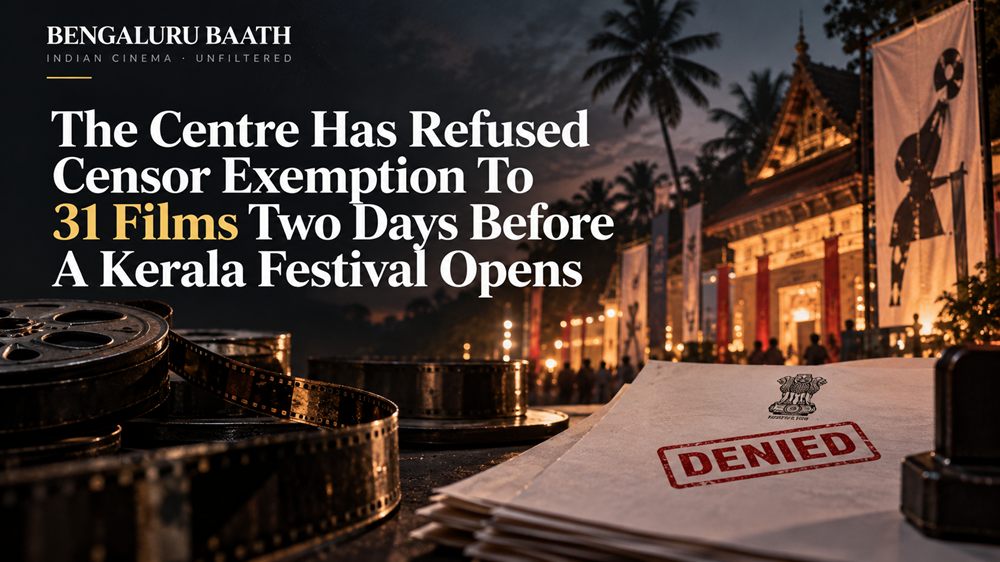
Thirty-one films scheduled for the 18th International Documentary and Short Film Festival of Kerala have been refused censor exemption by the Union Ministry of Information and Broadcasting, two days before the festival opens in Thiruvananthapuram on 25 September.
The Statesman reports that festival organisers submitted details for 347 films. The ministry asked for additional material, including detailed synopses and screeners, for 40 of them. It then denied exemption to 31 of those 40.
Kerala Culture Minister PC Vishnunadh has urged reconsideration, noting that the ministry did not give reasons for the denials.
What Happened
Indian film festivals operate through an exemption mechanism. Films screened at a recognised festival do not require CBFC certification, provided the ministry grants an exemption for the event. Without it, a film cannot legally be screened.
The denials cut across the festival’s programming rather than clustering in one section. Eighteen are from the official selection, nine from the International Non-Fiction section, three from the Festival Winners section and one from the Nepal Package.
The affected titles, as listed by The Statesman, are weighted toward documentary subjects that are politically or socially contested. They include Parliament Street, on public and personal memory in Delhi; Sanitised Republic: Cast(e) and Contracts, on sanitation workers during COVID-19; Globe, on tribal life in Kerala’s Attappady region; Put Your Soul on Your Hand and Walk, on life in Gaza; and Birds of War, on Lebanese and Syrian experiences of conflict and exile.
Onmanorama reported the position of one affected filmmaker, Shijin Govind, whose film Globe deals with tribal life in Attappady, describing the director as caught between the festival and the certification system.
There is a recent precedent. The Statesman notes that at last year’s International Film Festival of Kerala, 19 films were initially denied exemption and some were later cleared.
The Numbers
The scale of the denial:
| Item | Figure |
| Festival | 18th International Documentary and Short Film Festival of Kerala (IDSFFK) |
| Venue | Thiruvananthapuram |
| Opening date | 25 September 2026 |
| Films submitted for exemption | 347 |
| Films called for detailed review | 40 |
| Films denied exemption | 31 |
| From official selection | 18 |
| From International Non-Fiction | 9 |
| From Festival Winners | 3 |
| From Nepal Package | 1 |
| Reasons given by ministry | None stated |
| Precedent: IFFK last year | 19 films initially denied, some later cleared |
Figures as reported by The Statesman. Bengaluru Baath has not seen the ministry’s communication to the festival.
Why It Matters
The absence of stated reasons is the core of this. A denial without reasons cannot be argued with, appealed against on substance or corrected. It also cannot be distinguished from an arbitrary decision, which is precisely the problem.
The timing compounds it. A festival that opens on 25 September and learns on 23 September that 31 of its films cannot legally screen has no workable remedy. Programmes are printed, delegates have travelled, and slots cannot be refilled in 48 hours.
There is a structural point underneath the immediate one. Festival exemption exists because festivals serve a different function from commercial exhibition. They screen unfinished work, difficult work, and work made for an audience of a few hundred people. Routing that through the same gatekeeping as a wide theatrical release collapses a distinction the system was built to preserve.
The subject matter of the affected films will be read by many as the explanation. Bengaluru Baath is not in a position to assert that, because the ministry has not said anything. But when the denials fall disproportionately on documentaries about caste, tribal communities and Gaza, and no reasons are offered, the inference is available to anyone.
What They Said
Kerala Culture Minister PC Vishnunadh urged the ministry to reconsider and noted that it did not give reasons for the denials, as reported by The Statesman.
Bengaluru Baath has not seen a response from the Union Ministry of Information and Broadcasting, and no official statement from the ministry appears in the reporting we have checked.
The Bigger Picture
This lands three weeks after the CBFC issued revised certification guidelines, its first substantial overhaul in roughly 35 years. Bengaluru Baath wrote on 20 September that guidelines are text and precedent is what filmmakers actually plan around, and on 22 September that a commercial film had gone through the new process without a single cut.
Those two data points now sit beside this one, and together they describe the shape of the system fairly precisely. A well-financed commercial release with legal representation passed untouched. Thirty-one documentaries at a state festival did not get an answer at all.
The gap between the theatrical regime and the streaming self-regulation framework has been discussed for years. The gap that matters more may be the one between films with the resources to navigate the system and films without them.
Bengaluru Baath Take
No reasons. That is the whole story and it is worse than any reason they could have given. A denial you can read is a denial you can argue with, and the ministry has handed 31 filmmakers something that cannot be answered. Forty-eight hours before a festival opens, that is not a certification process, it is a scheduling weapon. We said on Sunday that vague standards get absorbed quietly at the script stage rather than fought in public. This is the version where they do not even need to be vague, because nobody has to say anything at all. Kerala has asked for a reconsideration. Watch whether one arrives before the 25th, because after that the question is moot.
More On Bengaluru Baath
Sources
- The Statesman, “31 films face screening uncertainty after Centre denies censor exemption ahead of Kerala film fest; why this happened?”, 23 September 2026
- Onmanorama, “Malayalam filmmaker caught in stand-off between Kerala film fest, CBFC”, 23 September 2026
- Kerala State Chalachitra Academy, “Festival organising body”, September 2026
- Business Standard, “From anti-national to offensive content: What are CBFC’s new film rules?”, September 2026