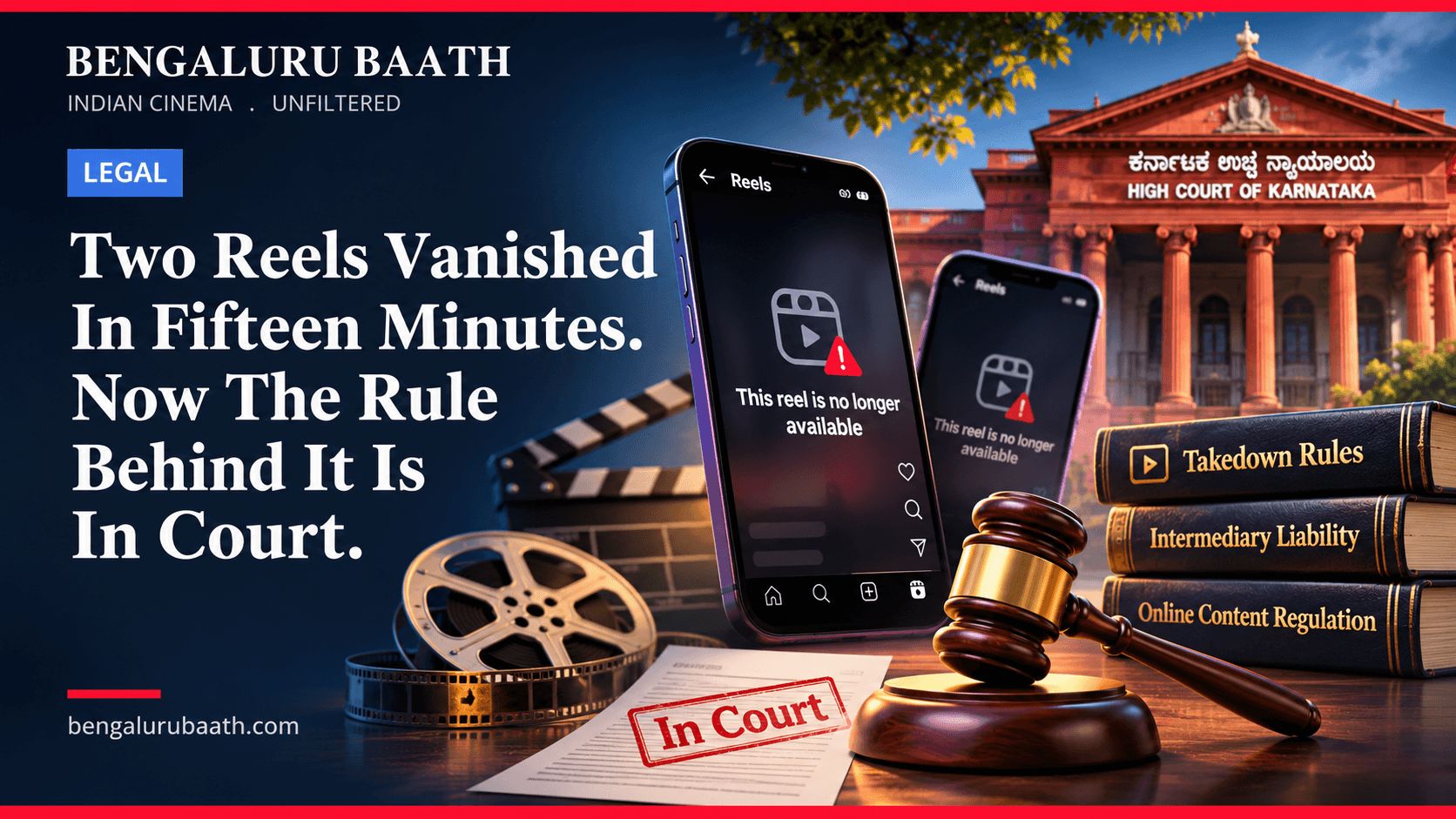
Two Instagram reels posted by a legal news site were made inaccessible within fifteen minutes of going up. On 19 November the Delhi High Court issued notice on the site’s challenge to the rule that it says made that possible.
This is not a film story on its face. It is the machinery that executes every takedown order this desk has covered this year, so it is very much our beat.
What the court did
A Division Bench of Acting Chief Justice Nitin Wasudeo Sambre and Justice Sanjay Sharma heard the matter on Thursday 19 November. The petitioners are LiveLaw Media and its Director, Sindhu T.P. The respondents are the Union of India through the Ministry of Electronics and Information Technology and the Ministry of Home Affairs, and Meta Platforms Inc.
The order is procedural and nothing more:
“We permit respondents to file their counter within four weeks. List on January 18, 2027.”
No interim relief was granted, and none was pressed. Counsel for the petitioner, Apar Gupta: “I am not pressing for interim relief today but a shorter date.” For the Union, Additional Solicitor General Chetan Sharma submitted the petition could be treated as a representation on which a speaking order would be passed after hearing the petitioner. Gupta called that “a mere formality.” The Court noted identical matters are listed for 9 February 2027.
No case number appears in any of the three reports we read. For a constitutional challenge to a rule governing automated censorship of the entire Indian internet, that is a reportable gap, and it is the same gap we keep finding: a Bengaluru court bound Google, Meta and X in a film matter and the court, judge and case number have never been published.
What is actually being challenged
Rule 4(4) of the Information Technology Rules, 2021, as amended in February 2026. It requires significant social media intermediaries to deploy automated tools to restrict content identical to information that has already been blocked.
Read that carefully. Not content a court has examined. Content identical to content already blocked, identified by machine, before anybody looks at it.
The petition pleads the rule is ultra vires the Information Technology Act, 2000 and violates Articles 14, 19(1)(a), 19(1)(g) and 21. It also challenges two MeitY advisories dated 8 and 10 October 2026 as having no statutory basis. The alternative relief sought is a reasoned intimation requirement under Rule 3(1)(d), restoration of the two reels, and disclosure of the legal requests behind the blocking.
From the petition, and these are allegations rather than findings:
“the impugned Rule, in the form in which it has been implemented, authorises a prior restraint upon publication.”
“The First Reel and the Second Reel were rendered inaccessible within fifteen minutes of their publication…”
A disclosure we owe readers
LiveLaw is the petitioner here, and it is also one of the sources this desk relies on most heavily for court reporting. Its account of this case is a party’s account of its own litigation and should be read that way. MediaNama and the Internet Freedom Foundation corroborate the hearing and the order; IFF appears to be supporting the petition, so treat it as interested too.
Why a film desk is writing this up
Because automated identical-content filtering is the thing on the other end of every order we report.
A Bombay High Court order of 6 November in the Ramayana piracy matter requires platforms and internet service providers to act on takedown notices from the plaintiff or its representative “immediately, and in any event within three hours of receipt”, and to confirm in writing that they have systems and personnel for real-time compliance. Three hours is not a human timescale for anything but triage. It is a machine obligation.
And the personality rights orders go the same way. Bombay granted an omnibus injunction on 5 November with no carve-out for news, review, criticism, satire or parody, seven days after Delhi refused exactly that and wrote the carve-out in. An automated filter cannot tell a parody from an infringement. It can only match.
So the live question is what happens when a court writes a free speech carve-out and the compliance layer has no way to honour it. Nobody argued that on 19 November. Somebody will have to by 18 January.
Bengaluru Baath Take
A rule that blocks content for resembling content already blocked is a rule that cannot distinguish the original from the critique of it. That is not a hypothetical objection, it is the design.
The timing is the part to hold on to. Fifteen minutes. Whatever the merits turn out to be, no human process in India works that fast, which tells you exactly what is doing the deciding. And a machine that only matches cannot read a free speech carve-out that a judge wrote out by hand three weeks ago.