On 15 October, Jailer 2 opened worldwide. Fifteen days later, trade tracker Sacnilk puts it at ₹766.65 crore gross worldwide, with ₹429.55 crore net in India and ₹264 crore from overseas. It is, by those figures, the biggest Tamil release of the year and one of the biggest Indian films ever made.
Rajinikanth is on the poster. Nelson Dilipkumar directed it. Sun Pictures paid for it. Anirudh scored it. Those four names have been in every headline for a fortnight.
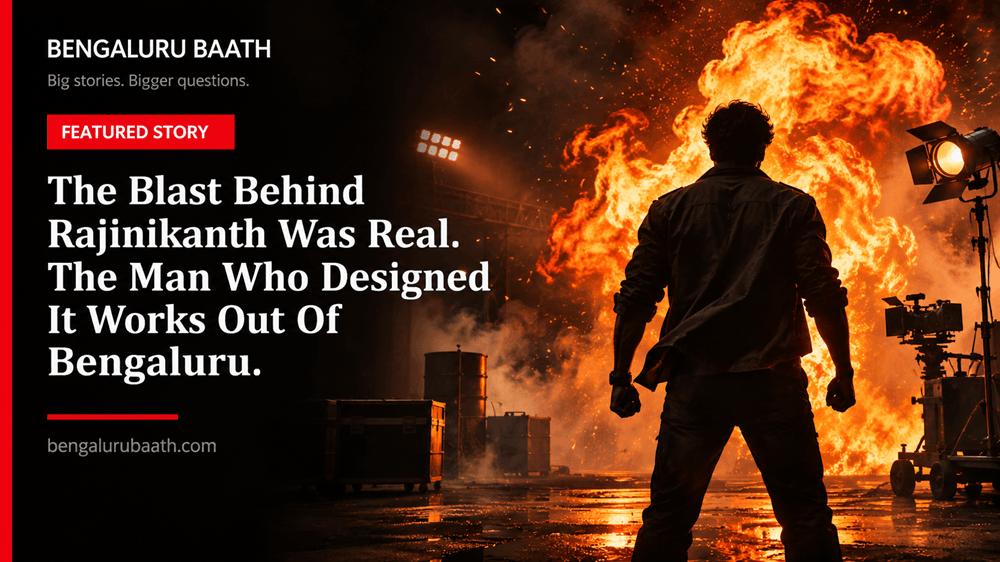
Here is a name that has not been: Chethan D’Souza. He designed the action. And the enormous building explosion that detonates behind Rajinikanth in the trailer, the shot that ran on every entertainment channel in the country for weeks, was not a visual effect.
“The blast behind Rajini sir that you have seen in the trailer is a live blast. We have enhanced it a little bit.”
— Chethan D’Souza, The CSR Journal, 15 October 2026
D’Souza is not from Chennai. He built his reputation in the Kannada industry, he runs an action design outfit called CF Action Design, and he co-founded a movement and combat training facility in Bengaluru called Chaos Faktory. Next Friday, 6 November, he is on screen again in Suriya’s Diwali release Scene.
Two of the biggest films in South India this quarter, and the man shaping how they move works out of this city. So this is the piece nobody writes.
The Big Question
What does an action director actually do in a ₹700 crore film, and why does nobody outside the industry know his name?
That is a real question with a checkable answer, because for once the man in question has given two detailed interviews in the space of a fortnight and said something specific about his method in both.
What The Numbers Say
First the film, with the usual Bengaluru Baath caveat attached. Everything below comes from a single tracker, Sacnilk. As we noted earlier this month, one tracker is currently doing almost all of the public box office reporting in India, and a figure with one source is a figure with one source. Treat these as reported, not audited.
| Jailer 2, 15 days (Sacnilk) | Figure |
| Worldwide gross | ₹766.65 crore |
| India gross | ₹502.65 crore |
| India net | ₹429.55 crore |
| Overseas | ₹264.00 crore |
| Opening day, India gross | ₹70.25 crore |
| Tamil net / Telugu net | ₹297.40 crore / ₹81.70 crore |
| Hindi net / Kannada net | ₹43.80 crore / ₹6.65 crore |
Note the overseas line, because it is the one doing the unusual work. ₹264 crore from overseas against ₹502.65 crore from India is a ratio almost no Indian film achieves. Roughly a third of this film’s money came from outside the country, and the thing that travels across a language barrier without subtitles is physical staging.
That is not an argument that the action made the film. Rajinikanth made the film. It is an argument that the department nobody credits is the department that works hardest on the export line.
Sources: Sacnilk, Jailer 2 box office · Wikipedia, Jailer 2 crew and production
The Career Context
D’Souza’s route into the biggest Tamil film of the year ran through Bengaluru and Kochi, not Chennai.
He came up in the Kannada industry, with credits including Bhairathi Ranagal, Max, Ghost, Bagheera and Upendra’s UI. He worked with director Pawan Kumar on U-Turn and later on Dhoomam. On his own account, his own description of his practice is twenty-two years across six film industries, with a background in competitive karate and combat and movement based performance training.
Then came 2024 and a Malayalam film that happens to be set in this city.
“It was the success of Aavesham that landed me Jailer 2.”
— Chethan D’Souza, SSBCrack News, 14 October 2026
Aavesham, directed by Jithu Madhavan, starred Fahadh Faasil as a Malayali-Kannadiga gangster in Bengaluru. It was made for a reported ₹30 crore and grossed over ₹156 crore worldwide, becoming the third Malayalam film to cross ₹100 crore in India. India Today’s Janani K specifically praised its “brilliantly choreographed action sequences”.
Follow the thread. A Kannada action specialist choreographs a Malayalam film about a Bengaluru gangster, and that film is what buys him a Rajinikanth project. He is now back with Jithu Madhavan on Scene, the Suriya action comedy releasing 6 November, produced by Suriya and Jyothika under Zhagaram Studios with 2D Entertainment on a reported ₹22 crore budget excluding Suriya’s fee.
Two years, three industries, one unbroken line.
In His Own Words
The most useful thing D’Souza has said is not about Rajinikanth. It is about design.
“First of all, we have designed fights based on the character itself… The idea is to show big things with minimal movement.”
— Chethan D’Souza, The CSR Journal, 15 October 2026
Minimal movement, for a seventy-five year old superstar, is not a compromise. It is the entire craft problem. Rajinikanth cannot and should not be doing wire work. So the job becomes making stillness read as power, which is a staging and editing problem rather than an athletic one.
He put the same idea more bluntly to Variety India.
“With stars, it is often less about how well they fight and more about their style and swagger.”
— Chethan D’Souza, Variety India, 26 October 2026
And on why the choreography is locked before anyone reaches the floor:
“We establish these moments in advance because the actors’ time and safety matter.”
— Chethan D’Souza, Variety India, 26 October 2026
He also described a moment on set that is worth reading twice, because it reverses the usual power arrangement of an Indian film unit. A performer was nervous and reacting badly to a move. Rajinikanth turned to the action director and asked whether he himself was doing it correctly.
“I never felt, even for a day, that I was working with a superstar… That humility, rather than an attitude of knowing everything, is part of his X factor.”
— Chethan D’Souza, Variety India, 26 October 2026
On Suriya, whose film arrives next week, he draws a different distinction.
“Suriya immerses himself in his character and explores every nuance… Every shot is considered; nothing is done merely for the sake of it.”
— Chethan D’Souza, Variety India, 26 October 2026
The Other Side
Now the uncomfortable part, because a profile is not a press release.
First, credit on an Indian film set is genuinely messy. Large productions routinely employ several action units. Jailer 2’s Wikipedia entry names D’Souza as action choreographer and specifically credits him with the announcement teaser, but a film shot across Kerala, Coimbatore, Mysore, Goa and Chennai over thirteen months will have had many hands on it. On Scene, the same encyclopedia credits him with an action sequence for Nazriya Nazim’s portions rather than the whole film. Precision matters here, and we are not going to inflate it.
Second, a live blast is a claim about process, not an achievement in itself. D’Souza himself says the shot was “enhanced a little bit”, and he has been clear elsewhere that vehicle impacts and larger explosions cannot be shot live at all. Practical is not automatically better. It is simply harder, and it is a choice.
Third, ₹766 crore belongs to Rajinikanth. The honest version of the argument in this piece is narrower: that a film which earns a third of its money overseas is being carried partly by things that do not need translation, and that the person responsible for those things is currently anonymous outside the trade.
The Industry Context
Zoom out and this is a story about the least protected job in Indian cinema.
Stunt performers and action units in India work without anything resembling the Hollywood safety apparatus. There is no equivalent of a standing industry-wide stunt safety regulator with enforcement power, insurance cover is inconsistent, and the people taking the physical risk are usually the lowest paid names on the call sheet.
The point is not abstract. On 14 May 2026, during a Jailer 2 shoot on East Coast Road in Chennai, a 28-year-old crew member died of an electric shock while carrying out electrical work. Filming was halted and police investigated. To be exact, because exactness is the whole job here: that was an electrical accident, not a stunt, and it did not involve the action department. But it happened on this film, on this schedule, and it is the reason a sentence like “the actors’ time and safety matter” deserves to be read as something other than a pleasantry.
D’Souza’s own practice lists mocap, previs and a fully equipped rigging and safety truck among its capabilities. Previsualisation and rigging are, in plain terms, how you stop guessing on the day. An industry that paid action directors properly and gave them prep time would have fewer accidents. That is not a sentimental claim. It is how every film industry that has reduced its injury rate has done it.
The Bengaluru Baath Take
Fact: Jailer 2 has done ₹766.65 crore in fifteen days on one tracker’s numbers, with a third of it from overseas. Fact: its action was designed by a man who built his career in Kannada cinema and trains fighters in Bengaluru. Fact: the building that explodes behind Rajinikanth in the trailer was really, mostly, blown up.
Interpretation, and we are labelling it: the Indian star system has a credit problem, and the action director is where it shows worst. We will name a cinematographer. We will absolutely name a music director, loudly, with a separate audio launch. We will not name the person who worked out how a seventy-five year old man can stand almost still and still read as the most dangerous thing on screen.
That specific skill, “show big things with minimal movement”, is the single most valuable craft idea anyone has said out loud about Tamil cinema this month. It is also the entire solution to the ageing-superstar problem that every industry in India is about to run into at once.
Chethan D’Souza is from here. He is on two of the biggest South Indian films of this quarter. On Friday he is on screen again with Suriya. Put him in the credits roll people actually read.