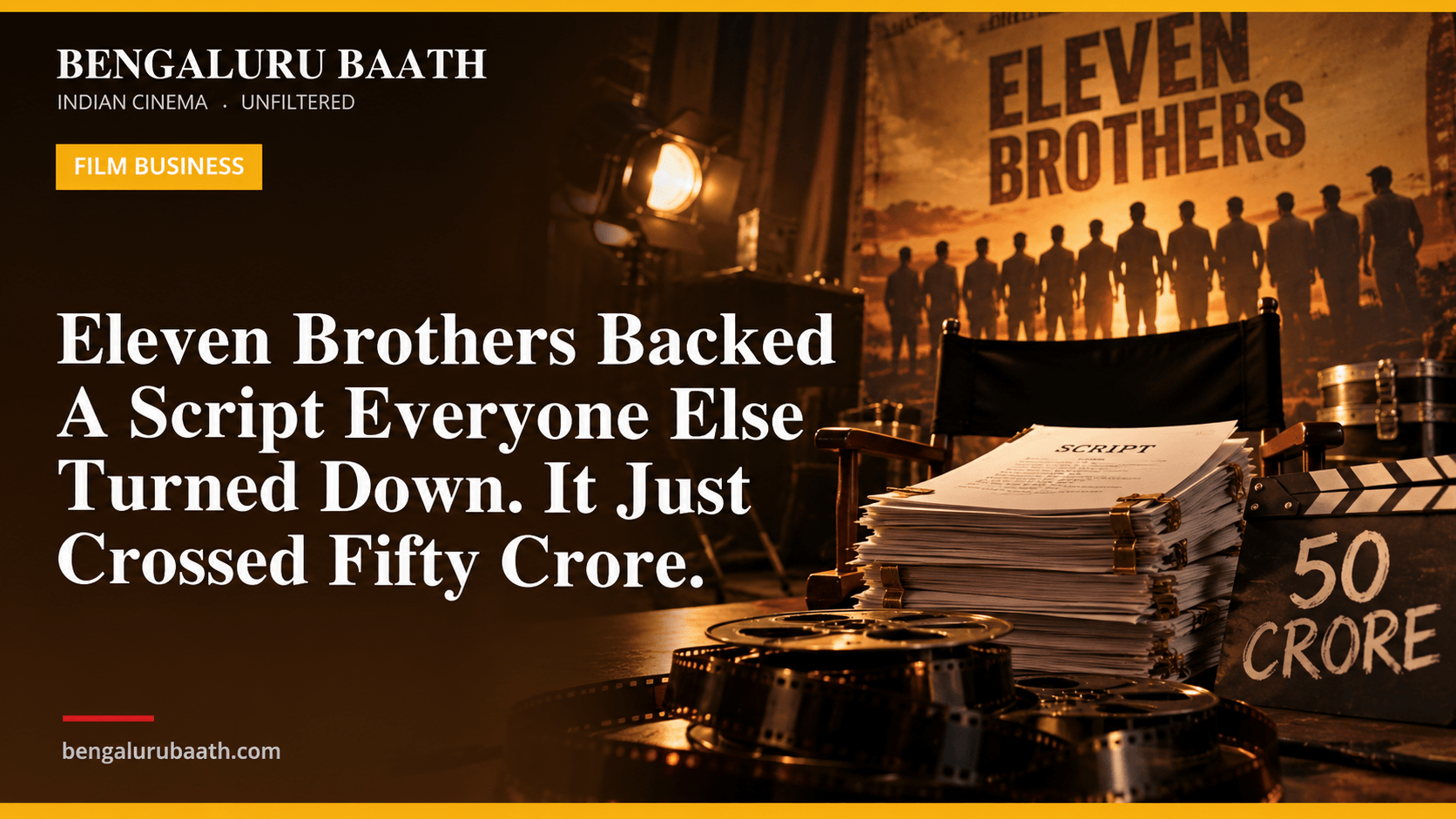
A Malayalam film made for about ₹15 crore, led by Parvathy Thiruvothu, directed by a man on his second feature, from a script that several producers had already said no to, has crossed ₹50 crore. The people who put up the money are eleven brothers from Theni in Tamil Nadu who had never made a film before.
Prathama Drishtya Kuttakkar released on 11 September. Madhyamam reports it has now entered the ₹50 crore club, and that this makes it the first ₹50 crore film of Parvathy Thiruvothu’s career. Shahad directs. The cast runs Vijayaraghavan, Parthiban, Mathew Thomas, Vinay Fort, Sidharth Bharathan, Unnimaya, Asees Nedumangad and Jayashree Shivadas, with Roby Raj on camera, Mujeeb Majeed on music and Chaman Chakko editing.
The production house is called 11 Icons Film Productions, and Onmanorama’s account of how it came to exist is the actual story here.
Who they are
Eleven of them, brothers and cousins from Theni district, already in business together across government contracts and a studio. Arjun Selva, a civil engineer, was twenty-nine when they started. One cousin came in as executive producer, another as line producer running the day to day. Selva’s explanation of the decision is about as unglamorous as film financing gets: “We have been involved in several businesses together. We equally love cinema and decided that we should start a film production house.”
The script came from P.S. Subramanian, a former police officer turned screenwriter, with Vijesh. Multiple producers had turned it down before these eleven said yes.
Read that list of rejections again
Every element of this film is something the industry currently describes as commercially unviable. A woman in the lead, not a male star. A courtroom and procedural register rather than a mass-appeal one. A first-time banner with no slate, no library and no streaming relationship to lean on. A budget under twenty crore in a market where the conversation is entirely about hundred-crore spectacles. And a writer whose qualification is that he used to be a cop, not that he had a hit.
It has done more than three times its budget. For comparison, the Hindi industry’s two big current releases needed opening days in the sixty-crore range to be considered working at all. A ₹15 crore film reaching ₹50 crore is a far better multiple than either, and nobody will build a conference panel around it.
The Parvathy line is the sharpest one
This is her first ₹50 crore film. Parvathy Thiruvothu has spent a decade and a half being the actor Malayalam cinema points to when it wants to prove it has range, and being the actor it does not finance. Her filmography is full of work the industry praises and then uses as evidence that serious films do not sell.
It took eleven men from outside the film business entirely, with no industry relationships to protect and no received wisdom to defend, to put a lead role in front of her in a film with enough money behind it to find an audience. The Malayalam industry had fifteen years and did not.
What the money actually tells you
There is a convenient story here about outsiders having better taste, and it is not quite true. What outsiders have is a different risk calculation. An established producer turning down this script was not making an aesthetic judgement. They were protecting relationships with stars, distributors and platforms whose preferences they have to keep satisfying next year and the year after. Saying yes to a woman-led procedural from a first-time writer costs them something inside that network even if the film works.
Eleven contractors from Theni have no network inside Malayalam cinema to damage. They read a script, liked it, could afford to be wrong, and said yes. That is not superior judgement. It is the absence of a career to lose, which in this industry turns out to be the scarcer asset.
One honest caveat on the figure. Neither report specifies whether the ₹50 crore is India or worldwide, and no budget number is confirmed on the record, so the roughly ₹15 crore cost should be read as reported rather than audited. The multiple is large enough that it holds either way.
Bengaluru Baath Take
Every producers’ association in the country spends its annual general body meeting explaining that audiences only want star vehicles and spectacle, and that content-driven cinema is a loss-making indulgence sustained by festivals. Then a group of engineers and contractors from Theni, who were not at any of those meetings, read a rejected script, backed a woman-led film at a fraction of the going budget, and tripled their money.
The lesson is not that anyone can do this. Most first-time producers lose everything, and survivorship bias is the oldest trick in film journalism. The lesson is narrower and more damning: the films the industry says will not sell are not actually being tested, because the people with the money will not test them. When somebody finally does, the result is interesting often enough to make the refusal look like a choice rather than a fact.
Also worth noting where this money came from. Tamil Nadu contractors financing a Malayalam film with a Tamil actor in the supporting cast. Nobody asked which industry it belonged to. Only the trade press does that.