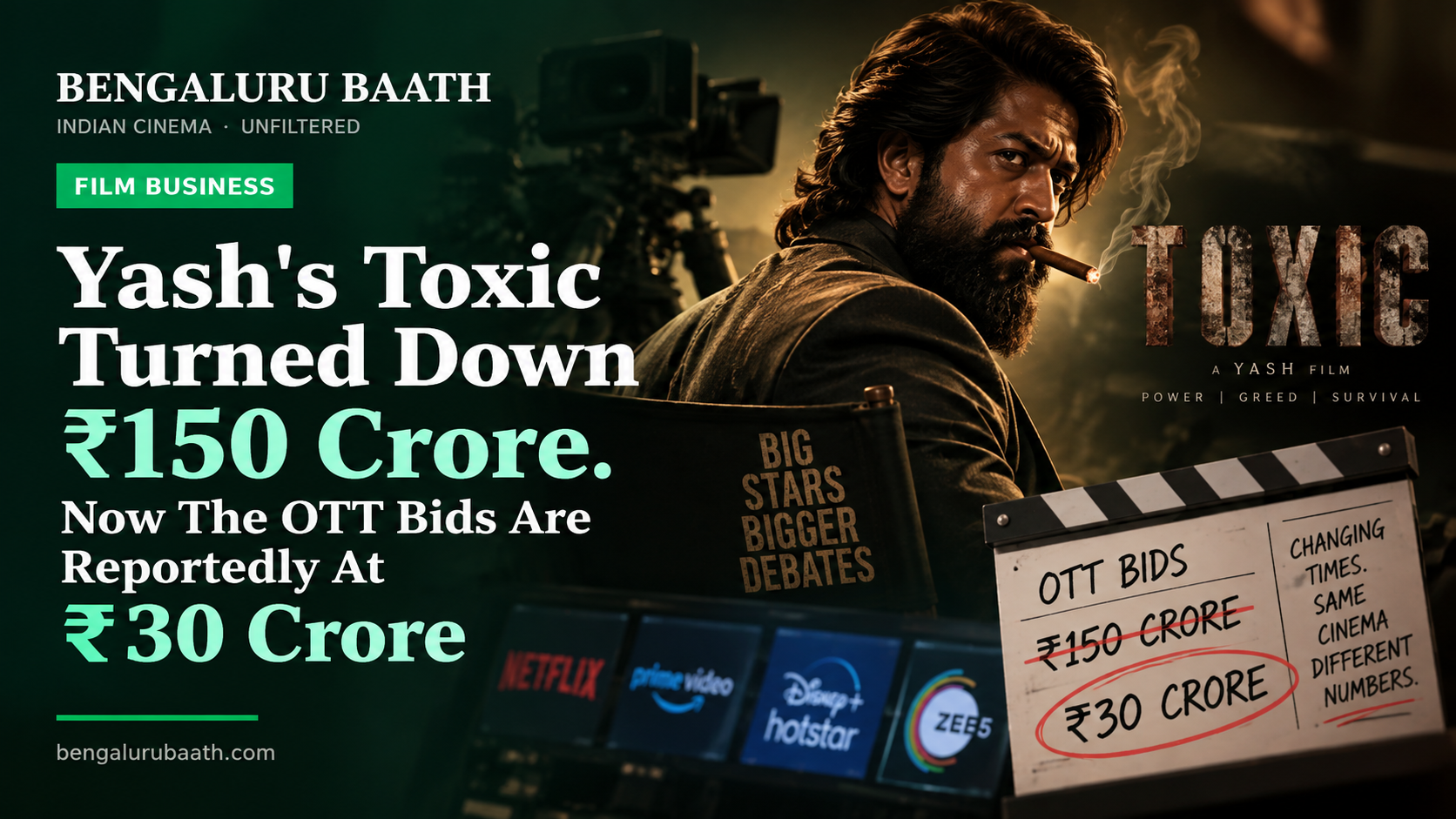
There is a specific kind of pain that only exists in the film business: turning down a very large cheque because you are certain a much larger one is coming.
Toxic reportedly did exactly that. And the follow-up cheque, according to trade reports, is now a fraction of the one that got refused.
Toxic: A Fairy Tale for Grown-Ups released on 26 August 2026. It is directed by Geetu Mohandas, produced by Venkat K. Narayana and Yash himself, and stars Yash in a dual role alongside Kiara Advani, Nayanthara, Huma Qureshi, Tara Sutaria and Rukmini Vasanth. Budget estimates run from ₹500 crore upward, which puts it in the conversation for the most expensive Indian film ever made.
The opening was genuinely enormous. Roughly ₹101 crore net in India on day one, about ₹140 crore worldwide. For a Kannada-language film that is historic.
Then the weekdays happened. Word of mouth turned sharply negative, collections dropped hard, and the film settled at roughly ₹328 crore worldwide by the time the run flattened out, per Wikipedia’s compiled figures, with other trackers reporting around ₹337 crore at day 12. Against a budget in that range, the maths does not work.
Here is the part that turns a box office story into a business story. The Week reports that before release, the producers received a digital rights offer of approximately ₹150 crore and turned it down, holding out for over ₹200 crore on the assumption that theatrical would deliver. Post-release, the reported bids have collapsed to around ₹30 crore, with Zee5 named as the platform still at the table. Makers are reportedly weighing an OTT-specific edit to make the film more streamable.
We want to be clear about what is confirmed here and what is not. The release date, cast, director, budget range and box office figures are documented. The specific deal numbers are trade reporting, attributed to sources, and have not been confirmed by any platform or by the producers.
For seven years, Kannada cinema’s pan-India story has been a straight line going up. KGF: Chapter 2 and Kantara made Hombale Films a national brand, and Kantara: Chapter 1 pushed past ₹850 crore. The lesson the industry took from that was: go bigger.
Toxic was that lesson taken to its logical extreme. An English-and-Kannada production, an auteur director in Geetu Mohandas making her big commercial swing, a cast assembled from four industries, and a budget that assumed a global audience would show up because Yash was in it.
Critically it did not land. Reviews were largely negative, with a low critic score on aggregators, and the recurring complaint was that the film leaned on style and star aura without a story underneath. Audiences reportedly flagged the violence, the adult content, the screenplay and the runtime.
Deccan Herald has been asking the obvious question in print: is pan-India ambition actively hurting Kannada cinema? Toxic is now the most expensive data point in that argument.
Confirmed: Toxic released 26 August 2026, directed by Geetu Mohandas, produced by Venkat K. Narayana and Yash, with Yash in a dual role. Budget estimated at ₹500 crore or more. Opening day of roughly ₹101 crore net India and ₹140 crore worldwide. Final worldwide gross reported in the ₹328 crore to ₹340 crore range. Critical reception was mostly negative.
Reported but not independently confirmed: the rejected pre-release offer of around ₹150 crore, the ask of over ₹200 crore, the current bid of around ₹30 crore, Zee5 as the remaining bidder, and the idea of a separate OTT cut. Treat all of those as trade reporting until a platform or the production house says otherwise.
Digital rights are not a bonus any more, they are the floor. For a film at this budget level, a pre-sold streaming deal is often the thing that makes the whole package financeable. When producers hold those rights back to chase a bigger post-release number, they are effectively betting the recovery of the film on opening weekend word of mouth.
Toxic is the clearest recent example of that bet going wrong in public. And the reported gap, from ₹150 crore to ₹30 crore, is not a haircut. It is a different business.
There is a knock-on effect for every Kannada producer currently pitching a big-budget film. Platforms price a film on expected viewership, not on what it cost to make. If the lesson streamers take from this is that Kannada tentpoles are risky at scale, the next ambitious Sandalwood project gets a smaller cheque before a single frame is shot. That is how one film’s failure becomes an industry’s ceiling.
Worth noting: a poor theatrical run does not automatically mean a poor stream. Plenty of films that underperformed in cinemas have found large audiences at home, particularly action films with recognisable stars, which is a fair description of this one.
Also worth noting: the reported plan for a separate OTT cut is not unusual. Recutting for the home viewer is a normal, if quiet, industry practice, and a tighter version of Toxic addressing the runtime complaint is a real possibility.
What the industry will actually be watching is the eventual announced price. If a deal lands publicly and the number is closer to the reported ₹30 crore than the rejected ₹150 crore, every producer in Bengaluru will read that as the new ceiling and price their next film accordingly.
BENGALURU BAATH TAKE
There is no joy in this one. Geetu Mohandas is a serious filmmaker, Yash is a genuine star, and a swing this big deserved better than the reception it got. But the business lesson here is brutal and worth sitting with: a pre-release OTT offer is not an insult to your film’s potential, it is insurance against the one weekend you cannot control. Somebody looked at ₹150 crore and saw a lowball. Whether that call was right will now be settled in public, on a platform, in front of everyone. The bigger worry is what this does to the next Kannada producer walking into a streamer’s office. Failure at this scale does not stay contained to one film.