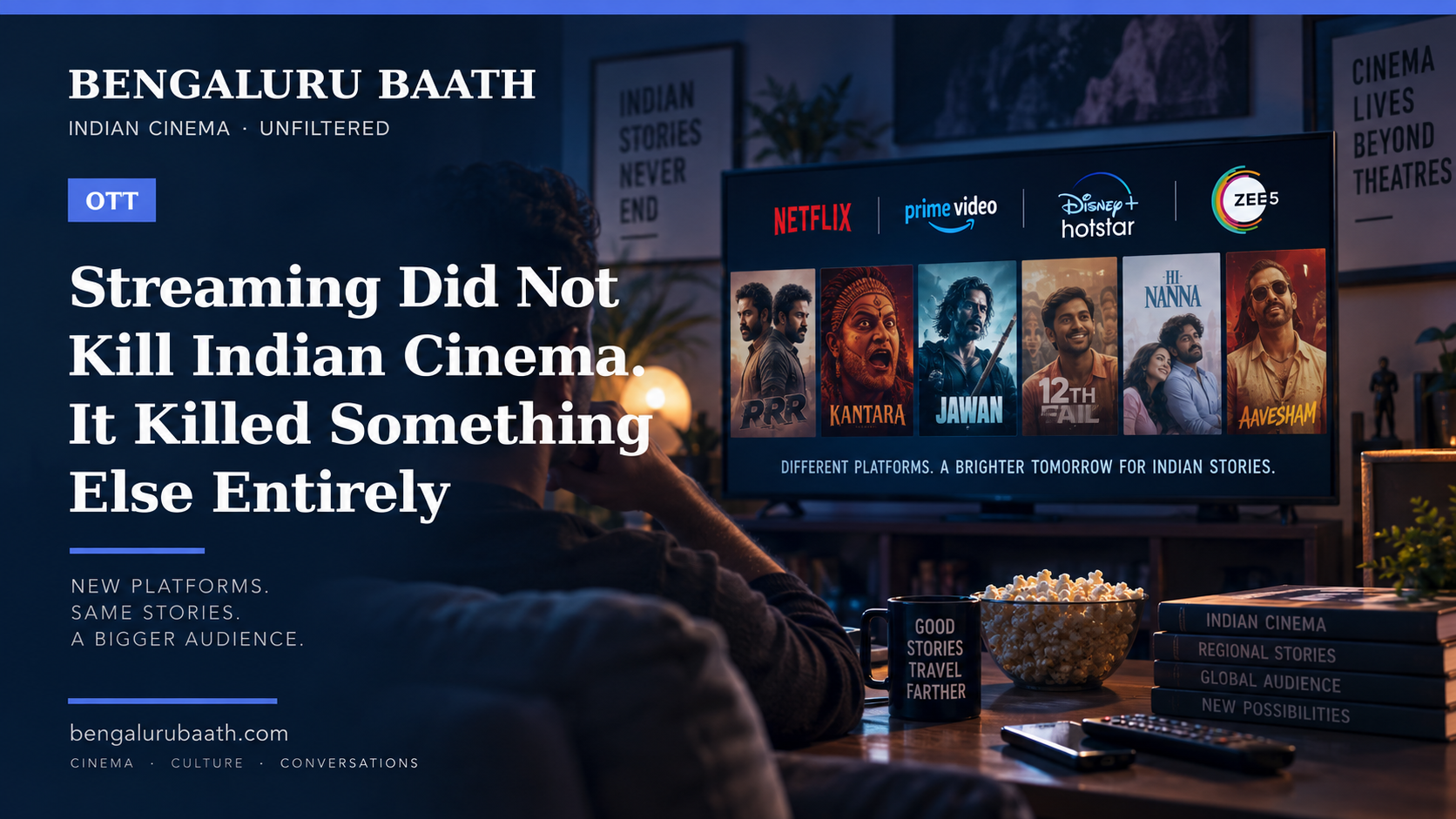
Ask anyone in the Indian film business what went wrong after 2020 and you will get one answer: OTT. It is a tidy explanation, it is emotionally satisfying, and it is only partly true.
The structural picture is documented. Astute Analytica reported Indian theatre revenue dropping 13 percent in a year as cinemas contended with the streaming boom. The FICCI-EY sector data, covered by Variety and LocalSamosa, consistently shows digital leading growth across the media and entertainment sector.
The Frontiers in Communication research paper on streaming and the evolution of Hindi cinema examines the shift academically rather than anecdotally.
What the aggregate data shows across recent years is a specific pattern: digital revenue growing strongly, television declining sharply, and film revenue volatile with an overall upward trend.
That third point is the one that breaks the simple story. If streaming had eaten theatrical, film revenue would show sustained decline. It does not. What shows sustained decline is television.
Indian cinema’s relationship with streaming changed fundamentally during the pandemic closures, when films that had no theatrical option went directly to platforms and audiences were trained into a new habit.
The more lasting change was financial. Digital rights went from being a secondary revenue stream to being, for many films, the difference between financing and not financing.
That created a new dependency. Producers began budgeting against expected digital sales, and when platform commissioning tightened and rights prices fell, the films built on those assumptions were exposed.
The current digital rights market illustrates this sharply. A major recent release reportedly saw its streaming valuation collapse after a weak theatrical run, which is only possible in a system where digital value is priced off theatrical performance.
Established: Indian theatre revenue has declined in recent reporting periods amid streaming growth; digital has led media and entertainment sector growth per FICCI-EY data; the theatrical window between cinema and streaming release has compressed substantially; digital rights have become a central component of film financing.
Analysis, labelled: the argument that streaming primarily displaced television rather than theatrical is an interpretation of the sector data, not a claim any single report makes in those terms.
Three consequences matter practically.
The first is the window. The gap between theatrical and streaming release has compressed dramatically, which changes audience behaviour: a viewer who knows a film arrives at home in four weeks makes a different decision about a ticket.
The second is the commissioning squeeze. The initial streaming boom produced enormous commissioning volume, and the subsequent correction left a lot of projects and people stranded. Platform consolidation has made that worse by reducing the number of serious buyers.
The third is the most positive and least discussed. Streaming has been transformative for regional Indian cinema’s reach. A Malayalam or Marathi film now finds audiences across India and internationally in a way that was structurally impossible before, and that has directly contributed to the rise in those industries’ national standing.
The theatrical business is not passive in this. Ticket prices at premium multiplexes rose substantially over the same period, which independently reduced footfalls, and the industry’s tendency to blame streaming for that is convenient.
The budget multiplex strategy that major chains are now pursuing is effectively an acknowledgement of that.
The honest summary is that theatrical cinema faces a real structural competitor for leisure time, that it also made its own pricing errors, and that the category streaming genuinely destroyed was linear television. All three things are true and only one of them gets discussed.
BENGALURU BAATH TAKE
The streaming-killed-cinema story is popular because it lets everyone off the hook. Harder version: the window got compressed because producers wanted the digital cheque, ticket prices went up because multiplexes wanted the margin, and the audience responded rationally to both. Meanwhile, the actual casualty of the streaming era was television, which nobody mourns because nobody in film ever liked it. The genuinely good news is buried under all this: a Malayalam film from a small town can now be watched in Delhi and Dubai. That is a bigger change than anything the box office numbers show, and it happened because of streaming, not despite it.
SOURCES & VERIFICATION
Verification status: CONFIRMED · Independent confirming sources: 5
- 1. Astute Analytica — https://www.astuteanalytica.com/news/indian-theatre-revenue-drops-13-percent-ott-boom
Confirms: Indian theatre revenue declining 13 percent amid the streaming boom. - 2. Variety — https://variety.com/2026/film/news/dhurandhar-record-2-18-billion-2025-indian-film-ficci-ey-report-1236697510/
Confirms: FICCI-EY sector data showing film revenue at a record and sector composition. - 3. LocalSamosa — https://www.localsamosa.com/news/ficci-ey-report-2026-media-and-entertainment-industry-11258234
Confirms: FICCI-EY data showing digital leading media and entertainment growth. - 4. Frontiers in Communication — https://www.frontiersin.org/journals/communication/articles/10.3389/fcomm.2026.1752623/full
Confirms: Academic analysis of streaming and the evolution of Hindi cinema. - 5. The Week — https://www.theweek.in/news/entertainment/2026/09/07/yash-toxic-digital-rights-streaming-setback.html
Confirms: Illustration of digital rights valuations being priced off theatrical performance.