INTRO / HOOK
Every film industry in the world has a neighbourhood. Los Angeles has Hollywood. Mumbai has Andheri. Chennai has Kodambakkam.
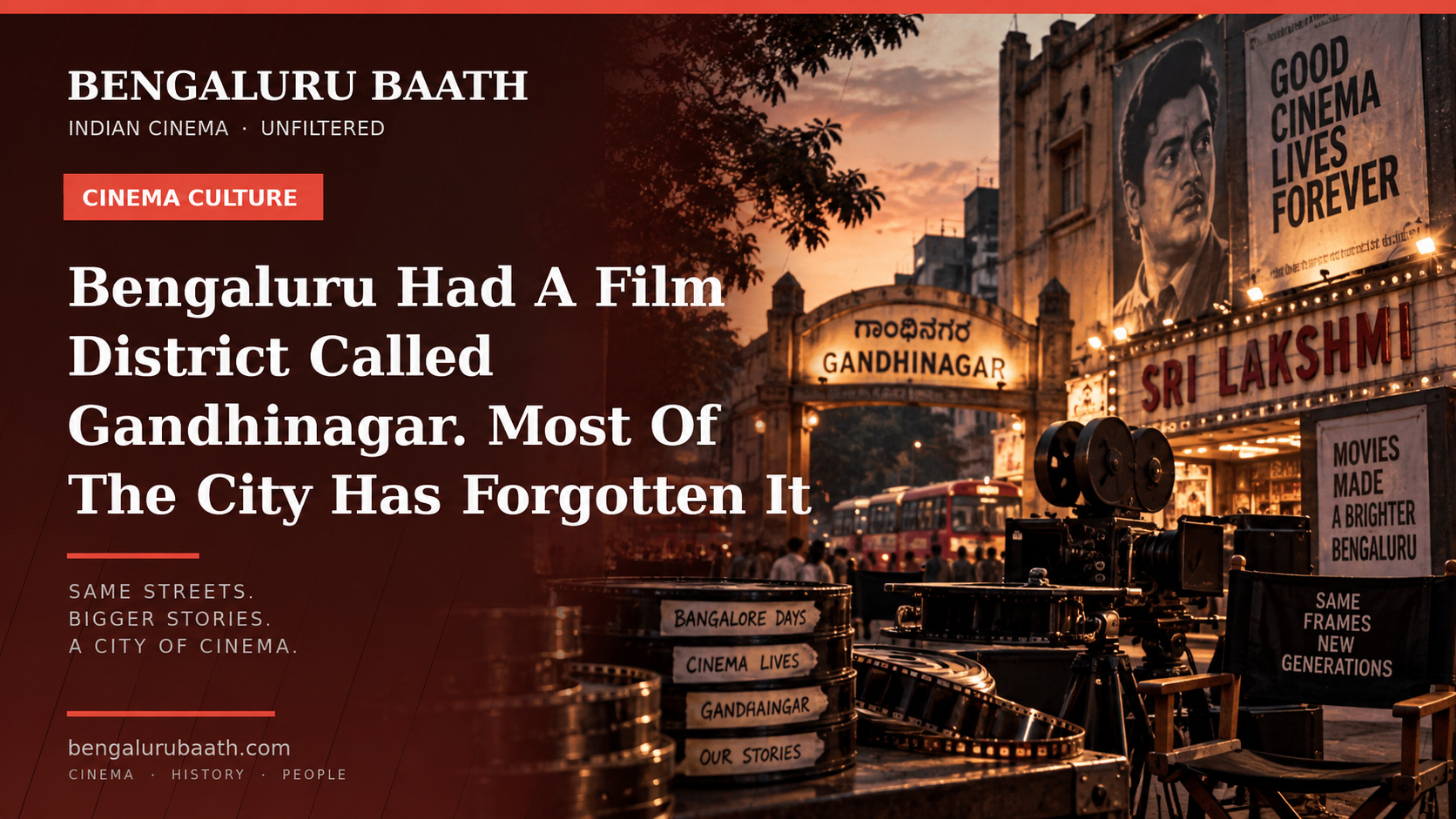
Bengaluru has Gandhinagar, and you can walk through it today without realising you are in it.
MAIN STORY
Gandhinagar, the area near Majestic in central Bengaluru, has been the administrative and commercial heart of Kannada cinema for decades. Production offices, distribution agents, poster printers, studios and the deal-making that actually constitutes a film industry were concentrated in a small cluster of streets.
ASAP Art’s feature on the slow decline of Bengaluru’s Kannada film industry traces that trajectory from Majestic to Gandhinagar and documents what has happened to the district.
Wikipedia’s entry on Kannada cinema records the industry’s institutional history, and Dr Rajkumar’s filmography documents the career that anchored it across five decades.
Social Observer’s account of Bedara Kannappa, released on 7 May 1954, marks the film that launched Rajkumar and is widely treated as a turning point for the industry.
BACKGROUND
Kannada cinema’s history has two distinct strands that rarely get discussed together.
The first is the popular industry, anchored overwhelmingly by Dr Rajkumar, whose career spanned from the 1950s to the 2000s and whose cultural standing in Karnataka went well beyond that of a film star. His filmography is extensive and his position in Kannada public life was closer to that of a cultural institution.
The second is the parallel cinema movement of the 1970s and 1980s, which produced filmmakers whose work was recognised at national and international level, and which academic writing on the Kannada new wave has documented in detail.
What Kannada cinema historically lacked was a commercial export route, which is the gap that KGF eventually filled forty years later.
WHAT WE KNOW
Established: Gandhinagar has been the historical centre of Kannada film production and distribution in Bengaluru; the district’s role has diminished over time; Dr Rajkumar’s career anchored the popular industry across five decades; Bedara Kannappa released in 1954 and is treated as a foundational film for his career; a Kannada new wave movement existed in the 1970s and 1980s and has been academically documented.
Analysis, labelled: assessments of why the district declined, and its current state, are drawn from published feature writing rather than official data.
WHY IT MATTERS
The physical geography of a film industry is not incidental. Clustering is how film industries work: proximity produces the informal exchange of information, credit, crew and opportunity that no amount of digital infrastructure replaces.
When the cluster disperses, the industry loses a form of institutional memory and a mechanism for new entrants to get in.
Bengaluru has a specific version of this problem. The city’s growth has been driven overwhelmingly by the technology sector, and central real estate has repriced accordingly. A film district operating on thin margins in central Bengaluru is competing for space against uses that can pay considerably more.
That is not a Kannada cinema problem, it is a Bengaluru problem that Kannada cinema is experiencing.
ADDITIONAL CONTEXT
There is an argument that the dispersal does not matter much any more, because production has decentralised, post-production is digital and deals happen over phones.
There is a stronger counter-argument. Every functioning film industry in the world still clusters, because the informal layer of a film business, the part where an assistant director meets a producer in a canteen, does not happen remotely.
Kannada cinema currently has more national credibility than at any point in its history. Whether it has a physical home in its own city to build that on is a question worth asking, and the answer at present is unclear.
For a publication called Bengaluru Baath, it is also not an abstract one.
BENGALURU BAATH TAKE
We will put our position plainly, since it is in our name. Bengaluru is one of the very few Indian cities with a genuine film industry, a genuine literary tradition and a genuine claim to national cultural weight, and it has spent twenty years describing itself exclusively as a technology capital. Gandhinagar is not a heritage site and nobody is asking for it to be preserved in aspic. But a city that produces KGF, Kantara and India’s biggest animated film, and cannot tell you where its film industry lives, has lost track of something. Ask a Bengalurean under thirty where Kannada films get made. Then ask them where the nearest tech park is.
SOURCES & VERIFICATION
Verification status: CONFIRMED · Independent confirming sources: 5
- 1. ASAP Art — https://asapconnect.in/post/449/singlestories/from-majestic-to-gandhinagar
Confirms: Feature tracing Gandhinagar’s role and the slow decline of Bengaluru’s Kannada film district. - 2. Wikipedia — Kannada cinema — https://en.wikipedia.org/wiki/Kannada_cinema
Confirms: Industry institutional history and development. - 3. Wikipedia — Dr. Rajkumar filmography — https://en.wikipedia.org/wiki/Dr._Rajkumar_filmography
Confirms: Documented filmography spanning five decades. - 4. Social Observer — https://socialobserver.in/latest-news/rajkumars-bedara-kannappa-kannada-movie-7th-may-1954-a-red-letter-day-in-kannada-film-industry/
Confirms: Bedara Kannappa’s 1954 release and significance for Rajkumar’s career. - 5. Veethika journal (QT Analytics) — https://qtanalytics.in/journals/index.php/VEETHIKA/article/download/646/397/986
Confirms: Academic documentation of the Kannada new wave movement.
IMAGE INFORMATION
Image status: NO_REUSABLE_PHOTO_FOUND / ORIGINAL_BB_CARD_CREATED
Image source: Original artwork generated by Bengaluru Baath
Image file: 046_Bengaluru_Had_A_Film_District_Called_Gandhinagar_Most_Of_The_City_Has_Forgotten_It.jpg
Photographer / copyright holder: Bengaluru Baath (original graphic)
Licence / usage: Original work owned by Bengaluru Baath. Free to publish, modify and syndicate.
Date created / downloaded: 2026-09-20
Photo-sourcing note: No third-party photograph could be licensed: this newsroom session’s network policy blocks Wikimedia Commons, Unsplash and Pexels, so no licence could be verified first-hand. Per Bengaluru Baath policy no copyrighted press photo was downloaded. An original BB featured card was generated instead. See image_sourcing_queue.csv for the exact photo brief.