INTRO / HOOK
There is a genre of Indian film article that appears every March, celebrates women filmmakers, and then disappears for eleven months. We are aware of the irony of writing one. We would like to make the case that this is a structural story rather than a seasonal one.
MAIN STORY
Outlook India’s feature, published under the heading macho no more, examines women directors in contemporary Indian cinema and the shift in what mainstream Indian films are willing to be about.
The Federal’s list of twenty women filmmakers who have redefined Indian cinema provides the historical spread, running from pioneers to current practitioners.
Siasat’s feature on female directors who shaped Indian cinema covers similar ground with different emphasis.
The Hollywood Reporter India’s Women in Entertainment Power List documents the current industry standing of women in Indian film and television, which is a useful corrective to purely creative framings: power in this industry is about who greenlights, not only who directs.
Wikipedia’s category listing for Indian women film directors gives some sense of the actual numbers, which remain small relative to the industry’s size.
BACKGROUND
Indian cinema has had women directors from very early on. Fatma Begum is generally credited as the first, directing in the 1920s, which is remarkably early by any international standard.
What has been persistently absent is not individual talent but a pipeline. Women have directed acclaimed Indian films in every decade, and the proportion of total films directed by women has remained low throughout.
The structural reasons are well documented across the industry: assistant director pathways that are difficult to sustain, financing networks that operate on personal relationships, and commercial filmmaking’s assumption that large-budget action films require a male director.
That last assumption has been tested repeatedly and has not held up, which has not stopped it functioning.
WHAT WE KNOW
Established: women have directed Indian films since the silent era; women directors are currently producing critically and commercially significant work across Indian languages; industry publications have documented both the creative contribution and the continuing structural underrepresentation; THR India maintains an annual power list documenting women’s positions across the Indian entertainment industry.
Not established here: current precise statistics on the proportion of Indian films directed by women, which are not consistently compiled across all language industries.
WHY IT MATTERS
The commercial argument is the one that should carry most weight in an industry that responds to commercial arguments.
Indian cinema has spent the last decade discovering audiences it had ignored: the small-town family audience, the devotional viewer, the regional-language diaspora. In each case the discovery followed someone making a film for a group the industry had not been serving.
Women are roughly half of the Indian cinema audience and a small fraction of the people deciding what gets made. Treating that as a fairness issue is correct and also undersells it. It is an unexploited market position.
The second argument is about range. The most interesting Indian films of recent years have tended to be the ones that came from outside the dominant commercial template, and a director pool that draws from a wider set of lives produces a wider set of films.
ADDITIONAL CONTEXT
One caution about how this story usually gets told. Grouping women directors as a category flattens enormously different filmmakers into a single narrative, and the individual work is more interesting than the collective framing.
The more useful thing any publication can do is cover the films specifically and on their own terms, throughout the year, rather than annually and as a group.
The practical measures that change the numbers are also well known: funding schemes, mentorship structures and hiring practices at production houses. They are unglamorous and they work, which is a description that fits most things that actually fix structural problems.
BENGALURU BAATH TAKE
We are writing the annual article, which is exactly the problem, so let us at least be useful about it. The industry’s own logic makes the case better than any argument about fairness: Indian cinema’s last decade of commercial discoveries all came from someone finally making a film for an audience that was being ignored. Half the audience is women and a very small share of the people deciding what gets made are. That is not primarily an ethics problem, it is a business one, and somebody is going to notice and make a great deal of money. Our commitment, for what it is worth: we will cover these films in the other eleven months too.
SOURCES & VERIFICATION
Verification status: CONFIRMED · Independent confirming sources: 5
- 1. Outlook India — https://www.outlookindia.com/art-entertainment/womens-day-2026-macho-no-more-women-directors-in-contemporary-indian-cinema
Confirms: Feature on women directors in contemporary Indian cinema and the shift in mainstream filmmaking. - 2. The Federal — https://thefederal.com/category/features/20-women-filmmakers-who-have-redefined-indian-cinema-112338
Confirms: Historical spread of women filmmakers who have redefined Indian cinema. - 3. The Hollywood Reporter India — https://www.hollywoodreporterindia.com/women-in-entertainment/women-in-entertainment-the-power-list-2026
Confirms: Annual power list documenting women’s positions across the Indian entertainment industry. - 4. Siasat — https://www.siasat.com/womens-day-2026-female-directors-who-shaped-indian-cinema-3426838/
Confirms: Independent feature on female directors who shaped Indian cinema. - 5. Wikipedia — Category: Indian women film directors — https://en.wikipedia.org/wiki/Category:Indian_women_film_directors
Confirms: Compiled listing giving scale context including early pioneers.
IMAGE INFORMATION
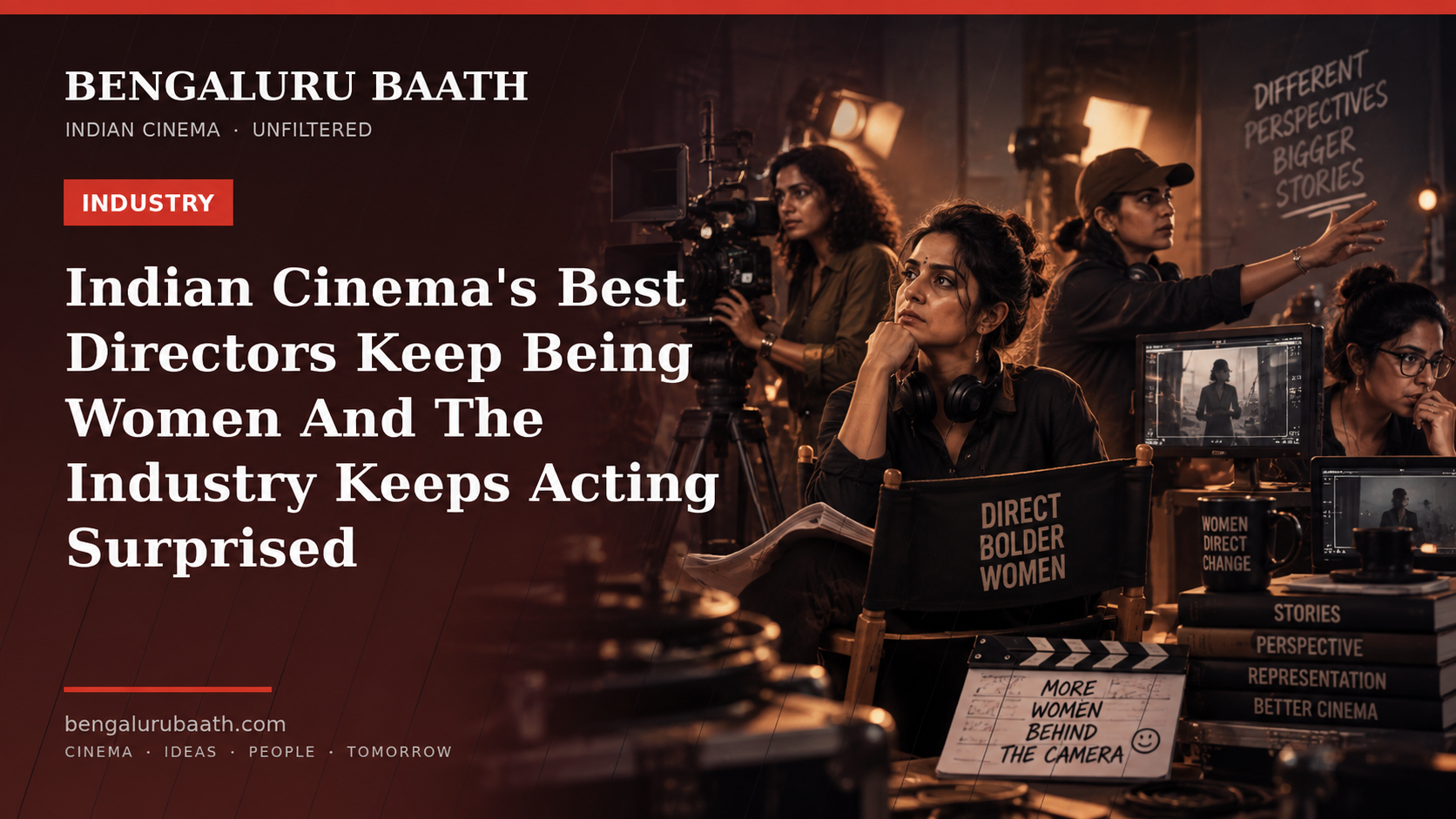
Image status: NO_REUSABLE_PHOTO_FOUND / ORIGINAL_BB_CARD_CREATED
Image source: Original artwork generated by Bengaluru Baath
Image file: 048_Indian_Cinemas_Best_Directors_Keep_Being_Women_And_The_Industry_Keeps_Acting_Surprised.jpg
Photographer / copyright holder: Bengaluru Baath (original graphic)
Licence / usage: Original work owned by Bengaluru Baath. Free to publish, modify and syndicate.
Date created / downloaded: 2026-09-20
Photo-sourcing note: No third-party photograph could be licensed: this newsroom session’s network policy blocks Wikimedia Commons, Unsplash and Pexels, so no licence could be verified first-hand. Per Bengaluru Baath policy no copyrighted press photo was downloaded. An original BB featured card was generated instead. See image_sourcing_queue.csv for the exact photo brief.