INTRO / HOOK
Netflix has spent a decade being the default global answer to the question of who runs streaming. In India, the answer is a platform most of the world has never heard of, and it is not close.
MAIN STORY
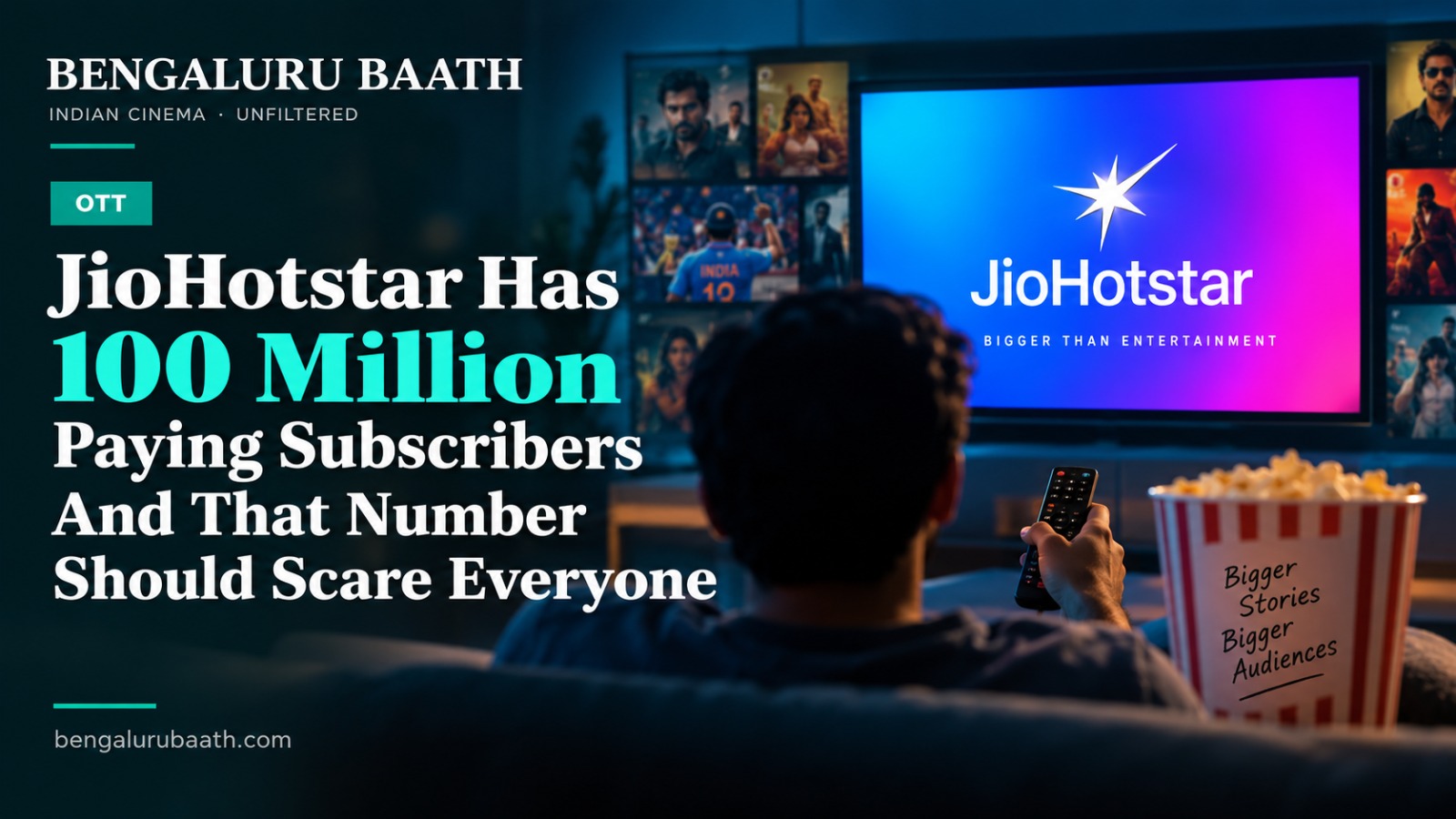
Variety reported JioHotstar reaching 100 million subscribers and framed it as a transformation of India’s streaming market. The Tech Portal reported the platform crossing 100 million paid subscribers, and Indian Broadcasting World independently confirmed the milestone.
Variety’s follow-up interview with the platform’s chief executive carried the line that they had reached a place no one has gone before, which is a claim about scale rather than modesty.
JioHotstar is the product of the merger between Reliance’s streaming operations and Disney’s Hotstar business in India, combining Disney’s content library and sports rights with Reliance’s distribution reach through its telecom network.
The subscriber number needs one piece of context to be read properly: Indian streaming pricing is a fraction of Western pricing. One hundred million Indian subscribers is not one hundred million dollars of Western ARPU. It is enormous reach at low revenue per user, which is a different business with different incentives.
BACKGROUND
India’s streaming market developed differently from everywhere else. It is mobile-first, price-sensitive, and driven substantially by cricket rather than drama.
Hotstar’s original growth was built almost entirely on IPL streaming rights, which produced concurrent viewership numbers that broke global records and had very little to do with scripted content.
The Reliance merger consolidated that sports position and added telecom bundling, which is the single most effective subscriber acquisition mechanism in the Indian market. When streaming comes attached to a mobile plan, the acquisition cost approaches zero.
That is a structural advantage that Netflix and Prime Video cannot replicate, because neither owns a telecom network in India.
WHAT WE KNOW
Confirmed: JioHotstar has crossed 100 million paid subscribers; the platform is the result of the Reliance and Disney streaming merger in India; the scale exceeds that of other streaming services operating in India.
Not established here: the current subscriber figure, which may have moved since the reported milestone; revenue per user; the split between sports-driven and content-driven subscriptions; and churn rates, which in a bundled-acquisition market are the number that actually matters.
WHY IT MATTERS
For Indian filmmakers, platform consolidation is a double-edged development. A single dominant buyer means fewer bidders for digital rights, which is exactly the dynamic visible in recent reporting on struggling OTT deals for big-budget films.
For regional cinema the picture is more positive. Scale of this kind requires content in many languages, and Indian streaming has been one of the better things to happen to Malayalam, Marathi and Bengali films in terms of reaching audiences outside their home states.
For the theatrical business, a streamer with 100 million paying households is a permanent structural competitor for leisure time, and no amount of window management changes that.
And for global streamers, India is now a market where the local incumbent has won on distribution. That is not a fight Netflix has lost anywhere else.
ADDITIONAL CONTEXT
The consolidation question is the one regulators elsewhere would already be asking. A merged entity combining the dominant sports rights position with the largest telecom distribution network is a concentration of market power that would attract scrutiny in most jurisdictions.
For content producers, the practical consequence is negotiating leverage. When there were four serious buyers for a film’s digital rights, prices were competitive. When there is one very large buyer and a few smaller ones, prices are whatever the large buyer decides.
That is not a hypothetical concern. It is visible in the digital rights market for Indian films right now.
BENGALURU BAATH TAKE
Everybody talks about streaming in India as a content story. It is a distribution story wearing a content costume. JioHotstar did not win because it commissioned better shows than Netflix, it won because it arrived attached to a phone plan in a country where the phone is the television. The part we would watch closely, if we were producers, is what happens to digital rights pricing when one buyer has this much of the market. The recent stories about big films struggling to find OTT deals at anything like their asking price are not separate from this news. They are the same story, told from the other side of the table.
SOURCES & VERIFICATION
Verification status: CONFIRMED · Independent confirming sources: 5
- 1. Variety — https://variety.com/2025/tv/news/india-jiohotstar-100-million-subscribers-1236349614/
Confirms: JioHotstar reaching 100 million subscribers and the resulting transformation of India’s streaming market. - 2. The Tech Portal — https://thetechportal.com/2025/03/27/jiohotstar-now-has-over-100-million-paid-subscribers/
Confirms: Independent confirmation that JioHotstar has over 100 million paid subscribers. - 3. Indian Broadcasting World — https://www.indianbroadcastingworld.com/jiohotstar-cross-100mn-subscribers/
Confirms: Trade-press confirmation of the 100 million subscriber milestone. - 4. Variety (CEO interview) — https://www.imdb.com/news/ni65217471/
Confirms: Platform leadership comments on reaching unprecedented scale. - 5. Wikipedia — Over-the-top media services in India — https://en.wikipedia.org/wiki/Over-the-top_media_services_in_India
Confirms: Market structure context for Indian streaming.
IMAGE INFORMATION
Image status: NO_REUSABLE_PHOTO_FOUND / ORIGINAL_BB_CARD_CREATED
Image source: Original artwork generated by Bengaluru Baath
Image file: 019_JioHotstar_Has_100_Million_Paying_Subscribers_And_That_Number_Should_Scare_Everyone.jpg
Photographer / copyright holder: Bengaluru Baath (original graphic)
Licence / usage: Original work owned by Bengaluru Baath. Free to publish, modify and syndicate.
Date created / downloaded: 2026-09-20
Photo-sourcing note: No third-party photograph could be licensed: this newsroom session’s network policy blocks Wikimedia Commons, Unsplash and Pexels, so no licence could be verified first-hand. Per Bengaluru Baath policy no copyrighted press photo was downloaded. An original BB featured card was generated instead. See image_sourcing_queue.csv for the exact photo brief.