INTRO / HOOK
Indian cinema had a record year. Indian producers are having a terrible time. Both of those things are true, and the explanation is not complicated once you look at where the money actually went.
MAIN STORY
The headline figures are documented. Variety’s coverage of the FICCI-EY report put Indian film at a record $2.18 billion with the wider media and entertainment sector at $29.6 billion. The Hollywood Reporter India reported the Indian box office crossing ₹13,000 crore with Bollywood at a record ₹5,504 crore, and examined the distribution of that across industries.
What those figures do not show is concentration. In 2026, Hindi cinema’s top three films account for a substantial share of the total, with Dhurandhar 2 entering the global top ten, Border 2 and Hanuman Ansh both crossing major thresholds.
The same pattern appears in other industries. Kantara: Chapter 1 crossed ₹852 crore. A small number of enormous films are generating a large share of the total.
Meanwhile, Forbes India’s reporting on exhibition and industry coverage of the commissioning environment describe a market where mid-sized releases struggle for screens, marketing spend and platform interest.
BACKGROUND
The mid-budget film is not a genre, it is a financing tier. It is the film made for a fraction of tentpole money that does not need a superstar to recover its cost.
Historically, that tier did most of the industry’s real work. It was where directors made their second and third films, where actors became stars, where writers learned structure, and where the occasional unexpected hit came from.
Several pressures have compressed it. Premium ticket pricing raised the revenue bar for a theatrical release to be viable. Streaming commissioning, which briefly absorbed the tier, contracted. Marketing costs rose to a level where a film without a large campaign is effectively invisible. And screen allocation increasingly favours the film that can fill a multiplex on Friday.
The result is a barbell: very large films and very small ones, with a thinning middle.
WHAT WE KNOW
Established: Indian film revenue and box office have reached record levels per FICCI-EY and trade reporting; a small number of films account for a large share of that total; exhibition and commissioning conditions for mid-sized films have tightened per industry reporting.
Analysis, labelled: the concentration argument and its consequences for talent development are an interpretation of the available figures, not a claim made by any single cited report.
Not established: precise revenue concentration ratios, which are not published in a standardised form.
WHY IT MATTERS
The talent pipeline is the concrete consequence. Nearly every major Indian director working at tentpole scale today made their reputation on a mid-budget film. Remove that tier and the industry has no mechanism for finding the next generation.
The second consequence is systemic risk. An industry where ten films generate most of the revenue is fragile. One weak quarter at the top becomes an industry-wide crisis, because there is no broad base of moderately profitable films absorbing the shock.
The third is variety. A barbell market produces spectacle and micro-budget work, and much less of the well-made film for adults that used to be Indian cinema’s reliable middle ground.
Malayalam cinema is the significant counter-example, having preserved its middle tier by keeping costs proportionate throughout.
ADDITIONAL CONTEXT
There are routes back, and none of them are mysterious.
Differential pricing, which some chains are now attempting through budget formats, lowers the revenue bar for a smaller film. Streaming platforms committing to volume rather than only to prestige titles restores a buyer for the tier. And production houses that treat mid-budget films as development investment rather than as standalone profit centres have historically done very well out of it.
The obstacle is that none of these produce a headline number in a quarter, and the Indian industry’s attention is almost entirely directed at headline numbers.
Which is, in a sense, the whole problem described in one sentence.
BENGALURU BAATH TAKE
Every celebration of a record box office year should come with a second number attached: how many films made it. When the answer is ten, the correct response is concern rather than applause. The mid-budget film is where directors learn, where actors become worth casting and where the surprises come from, and it is being squeezed out by a combination of ticket prices, marketing costs and screen allocation that nobody individually decided on. Malayalam cinema kept its middle and is currently the most interesting film industry in the country. That is not a coincidence, and it is not a mystery either.
SOURCES & VERIFICATION
Verification status: CONFIRMED · Independent confirming sources: 5
- 1. Variety — https://variety.com/2026/film/news/dhurandhar-record-2-18-billion-2025-indian-film-ficci-ey-report-1236697510/
Confirms: Record $2.18 billion Indian film revenue and $29.6 billion media and entertainment sector per FICCI-EY. - 2. The Hollywood Reporter India — https://www.hollywoodreporterindia.com/features/insight/2025-india-box-office-crosses-historic-13000-crore-as-bollywood-hits-record-high-of-5504-crore-but-how-did-other-industries-fare
Confirms: Indian box office crossing ₹13,000 crore with an industry-by-industry breakdown. - 3. Forbes India — https://www.forbesindia.com/article/showstoppers-2026/how-single-screens-keep-the-show-running-with-nostalgia-and-fandom/2997582/1
Confirms: Exhibition conditions and the state of the Indian cinema-going market. - 4. The Week — https://www.theweek.in/news/entertainment/2026/09/15/hanuman-ansh-box-office-day-39-collection-record.html
Confirms: Concentration of 2026 Hindi box office in a small number of very large films. - 5. Deccan Herald — https://www.deccanherald.com/india/karnataka/big-budgets-bigger-losses-is-pan-india-ambition-hurting-kannada-cinema-3932186
Confirms: Reporting on big-budget losses and the pressures on regional production economics.
IMAGE INFORMATION
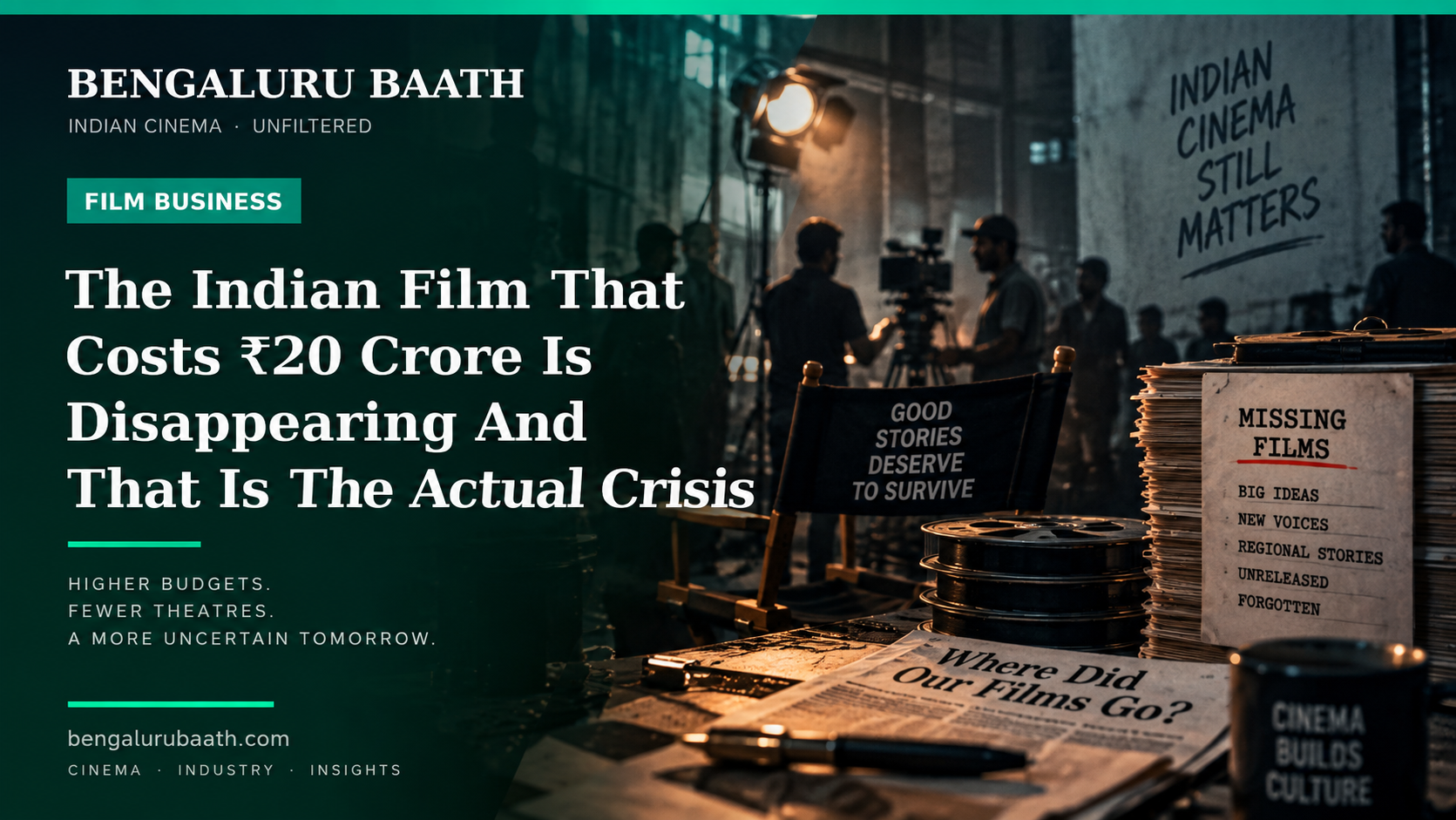
Image status: NO_REUSABLE_PHOTO_FOUND / ORIGINAL_BB_CARD_CREATED
Image source: Original artwork generated by Bengaluru Baath
Image file: 049_The_Indian_Film_That_Costs_20_Crore_Is_Disappearing_And_That_Is_The_Actual_Crisis.jpg
Photographer / copyright holder: Bengaluru Baath (original graphic)
Licence / usage: Original work owned by Bengaluru Baath. Free to publish, modify and syndicate.
Date created / downloaded: 2026-09-20
Photo-sourcing note: No third-party photograph could be licensed: this newsroom session’s network policy blocks Wikimedia Commons, Unsplash and Pexels, so no licence could be verified first-hand. Per Bengaluru Baath policy no copyrighted press photo was downloaded. An original BB featured card was generated instead. See image_sourcing_queue.csv for the exact photo brief.