INTRO / HOOK
Everybody in India knows how Sholay ends. Almost nobody in India has seen how Sholay actually ended.
MAIN STORY
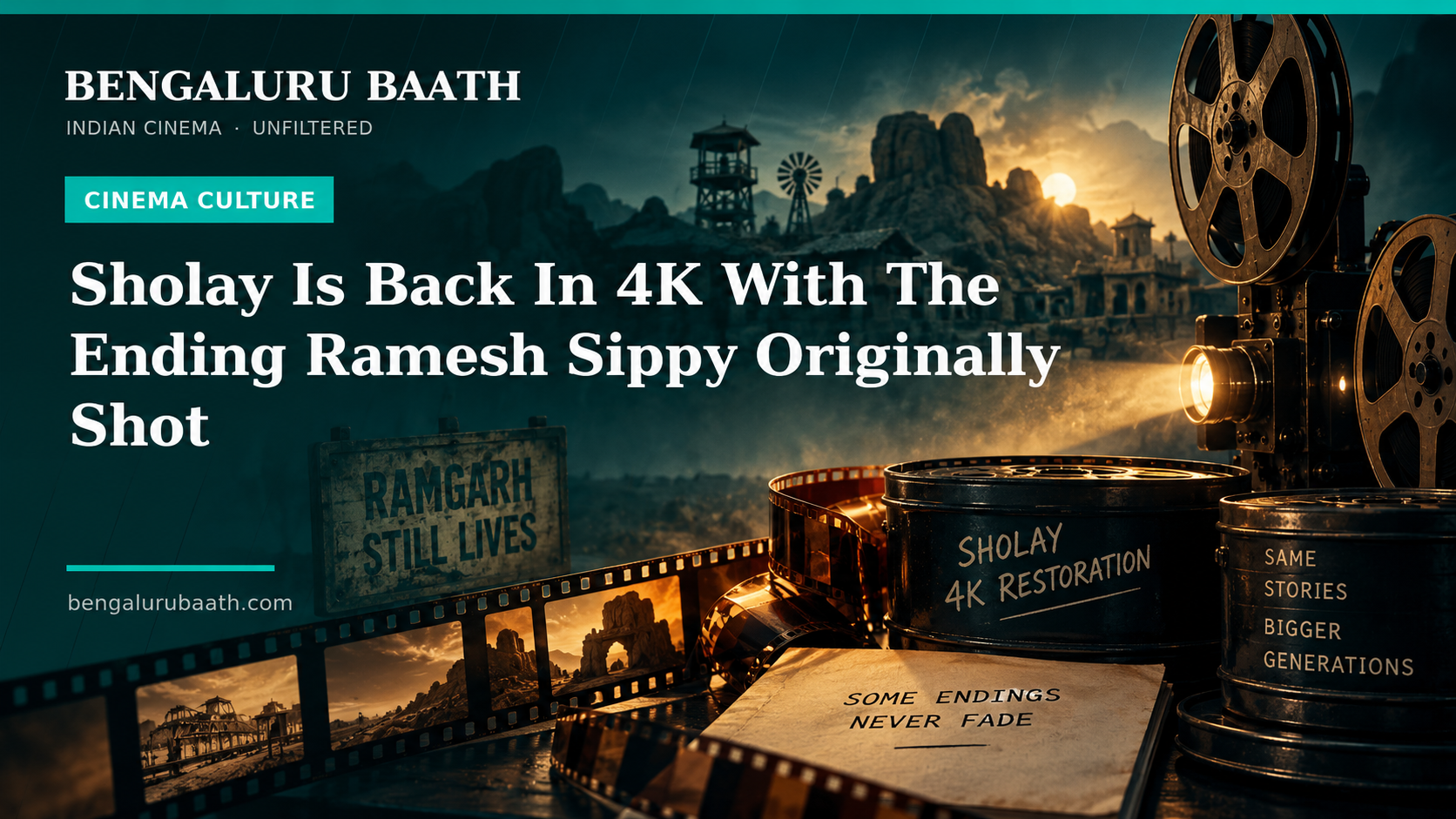
Sholay: The Final Cut has returned in a restored 4K version carrying the original ending, per Gulf News, which reported the restoration and the return of the ending as it was originally shot.
Variety reported the trailer unveiling ahead of the 50th anniversary release. The Federal carried an interview with Shehzad Sippy on restoring the uncut version in 4K, the family’s involvement, and what the restoration process required.
Gulf News separately reported the London Film Festival honouring the film at 50.
The ending is the headline. In the version released in 1975, the climax was altered following censor objections during the Emergency period. The restored version presents the ending Ramesh Sippy originally shot, alongside restored footage cut from the theatrical version.
BACKGROUND
Sholay released on 15 August 1975 and famously opened to indifferent business before word of mouth turned it into the defining Hindi film of its era. It ran for years, its dialogue entered the language, and Gabbar Singh became the template against which Hindi cinema villains are still measured.
The 1975 release coincided with the Emergency, a period of suspended civil liberties and heightened censorship, and the film’s climax was altered in that context.
Film restoration in India has historically been poor. A significant portion of India’s silent and early sound film heritage is simply lost, destroyed by neglect, fire and the recycling of nitrate stock. A major restoration of a canonical film, done properly and in 4K, is therefore an event beyond the film itself.
WHAT WE KNOW
Confirmed: a restored 4K version of Sholay has been presented as Sholay: The Final Cut; it carries the original ending that was not in the 1975 theatrical release; the restoration was undertaken with involvement from the Sippy family; a trailer was released ahead of the 50th anniversary; the London Film Festival honoured the film at 50.
Not established here: the full list of restored scenes, the technical details of the restoration source elements, and the theatrical and home release plans in every territory.
WHY IT MATTERS
There is a preservation argument and a cultural one.
The preservation argument is that India’s film heritage is disappearing and that high-profile restorations are the most effective way to build the institutional and commercial case for saving it. A successful Sholay restoration makes the next restoration easier to fund.
The cultural argument is more specific to this film. Sholay’s altered ending is one of the clearest surviving artefacts of Emergency-era censorship in Indian popular cinema. Restoring it does not just complete a film, it restores a piece of evidence about what was done to it and why.
For younger audiences, there is a simpler point: this is a chance to see the most influential Hindi film ever made in a version its director actually intended, on a screen, rather than in a degraded television print.
ADDITIONAL CONTEXT
Re-releases have become a significant commercial category in Indian cinema over the last few years, with restored classics regularly outperforming new mid-budget releases in limited runs.
That has changed the economics of restoration from a heritage project to a business proposition, which is probably the only thing that will actually save Indian film history at scale.
On the ending itself: audiences who know the film intimately will find the difference substantial rather than cosmetic. It changes the moral weight of the climax, which is presumably why it was objected to in the first place.
BENGALURU BAATH TAKE
Fifty years is a long time to wait to see a film finish properly. What strikes us about this restoration is less the 4K and more the fact that the original ending survived at all, given how casually India has treated its own film prints. Half the country’s early cinema is gone. Sholay’s cut footage existing in a restorable state is partly diligence and partly luck. Watch it on the biggest screen you can find, and then consider how many other films did not get this lucky. The restoration is a gift. The bigger story is the archive nobody funded.
SOURCES & VERIFICATION
Verification status: CONFIRMED · Independent confirming sources: 4
- 1. Gulf News — https://gulfnews.com/entertainment/bollywood/sholay-the-final-cut-returns-with-original-ending-and-restored-4k-magic-1.500373125
Confirms: Sholay: The Final Cut returning with the original ending and 4K restoration. - 2. Variety — https://variety.com/2025/film/news/sholay-trailer-50th-anniversary-release-1236600849/
Confirms: Trailer unveiled ahead of the 50th anniversary release. - 3. The Federal — https://thefederal.com/films/sholay-50th-anniversary-restoration-shehzad-sippy-ramesh-sippy-classic-hindi-film-201860
Confirms: Shehzad Sippy interview on restoring the uncut version in 4K. - 4. Gulf News (LFF) — https://gulfnews.com/entertainment/bollywood/sholay-at-50-london-film-festival-honours-a-legend-1.500297515
Confirms: London Film Festival honouring Sholay at 50.
IMAGE INFORMATION
Image status: NO_REUSABLE_PHOTO_FOUND / ORIGINAL_BB_CARD_CREATED
Image source: Original artwork generated by Bengaluru Baath
Image file: 025_Sholay_Is_Back_In_4K_With_The_Ending_Ramesh_Sippy_Originally_Shot.jpg
Photographer / copyright holder: Bengaluru Baath (original graphic)
Licence / usage: Original work owned by Bengaluru Baath. Free to publish, modify and syndicate.
Date created / downloaded: 2026-09-20
Photo-sourcing note: No third-party photograph could be licensed: this newsroom session’s network policy blocks Wikimedia Commons, Unsplash and Pexels, so no licence could be verified first-hand. Per Bengaluru Baath policy no copyrighted press photo was downloaded. An original BB featured card was generated instead. See image_sourcing_queue.csv for the exact photo brief.