INTRO / HOOK
Hollywood spent 2023 shutting down production over AI. Actors picketed. Studios negotiated. Contracts were rewritten.
India had roughly the same technological disruption arrive at roughly the same time, and almost nobody outside the affected profession noticed.
MAIN STORY
The Hollywood Reporter published reporting titled directly: AI is replacing voice artists in India, and there are no local laws to stop it. The Hollywood Reporter India carried the same reporting for the Indian market.
Rest of World reported on voice actors fighting to protect their livelihoods and local language cultures from AI dubbing, framing it as part of a wider international push.
The Hollywood Reporter has separately reported that the AI revolution Hollywood feared is already happening in India, describing adoption in Indian filmmaking ahead of comparable Western uptake.
The Federal has reported on how AI is shaping Indian filmmaking more broadly, including applications like de-aging.
The core, consistently reported fact is this: AI dubbing and voice synthesis are being used commercially in India, displacing paid human work, and India has no specific statutory framework governing performer likeness or voice rights in this context.
BACKGROUND
India is uniquely exposed here because of language. A single Indian film may be dubbed into six or more languages, and the dubbing industry that serves that need employs a large number of skilled professionals who are largely invisible to audiences.
That work is also, from a producer’s perspective, a clear cost line with a technologically available substitute. AI dubbing is faster, cheaper, and can preserve the original actor’s vocal characteristics across languages.
The legal gap is the crucial part. Indian copyright law protects works. Personality rights have developed through case law, largely around celebrity endorsement, and Indian courts have issued orders protecting well-known personalities’ voice and likeness. What does not exist is a statutory framework covering ordinary working performers, which is exactly who is being displaced.
WHAT WE KNOW
Confirmed by multiple independent international outlets: AI voice technology is being used commercially in Indian dubbing; voice artists report loss of work; India lacks a specific legal framework regulating this; Indian filmmaking has adopted AI tools at a pace that international trade press describes as ahead of Hollywood.
Not established: the scale of displacement in employment numbers, the specific productions involved, and whether any Indian industry body has negotiated protections. Individual claims about specific films should be checked against the productions themselves.
WHY IT MATTERS
The immediate harm falls on a profession most people have never thought about. Dubbing artists are working professionals with specialised skills, and in many Indian languages the dubbing voice for a major star is a recognisable cultural presence in its own right.
The second-order effect is on language itself. Rest of World’s framing is worth taking seriously: AI dubbing tends to be trained on dominant language data, and the risk is a flattening of regional linguistic texture, dialect and idiom, in favour of a standardised synthetic register.
For Indian cinema, which is defined by linguistic specificity more than almost any other film culture, that is not a small risk.
The third effect is precedent. Voice is the easiest performance element to synthesise, which makes it the first. It will not be the last.
ADDITIONAL CONTEXT
Hollywood’s response was collective bargaining, and it worked because the unions had the power to stop production. Indian film industries have craft associations and federations with varying degrees of leverage, and the dubbing profession is among the least organised.
There is also a genuine argument on the other side that deserves airing. AI dubbing makes it economically viable to release a regional film in languages where a human dubbing budget could never be justified, which expands access for smaller films.
The honest position is that both things are true, and that the absence of any framework means the benefit accrues to producers while the cost falls entirely on workers. A rule that allowed the former while compensating the latter is not technically difficult. It just does not exist.
BENGALURU BAATH TAKE
We keep noticing that when this story is told in Los Angeles it is a labour rights crisis, and when it happens in Mumbai and Chennai it is described as efficiency. The dubbing artists losing work are not abstractions, they are people with decades of craft in an industry that has always undervalued them. And the language point is the one that should worry anyone who cares about Indian cinema specifically. A country with this many languages replacing human voice work with a synthesised average is a country quietly sanding down the thing that makes its cinema interesting. Nobody needs to ban the technology. Somebody does need to write a rule.
SOURCES & VERIFICATION
Verification status: CONFIRMED · Independent confirming sources: 5
- 1. The Hollywood Reporter — https://www.hollywoodreporter.com/movies/movie-news/ai-is-replacing-voice-artists-in-india-1236335714/
Confirms: AI replacing voice artists in India with no local laws to stop it. - 2. Rest of World — https://restofworld.org/2026/ai-voice-actors-hollywood-dubbing/
Confirms: Voice actors fighting to protect livelihoods and local language cultures against AI dubbing. - 3. The Hollywood Reporter (AI filmmaking) — https://www.hollywoodreporter.com/business/digital/india-ai-filmmaking-1236548136/
Confirms: The AI revolution Hollywood feared already happening in Indian filmmaking. - 4. The Hollywood Reporter India — https://www.hollywoodreporterindia.com/features/insight/artificial-intelligence-is-replacing-voice-artists-in-india-and-there-are-no-laws-to-stop-it
Confirms: Indian trade coverage of AI displacing voice artists and the absence of legal protection. - 5. The Federal — https://thefederal.com/films/artificial-intelligence-ai-future-of-filmmaking-india-cinema-de-aging-182480
Confirms: How AI is shaping Indian filmmaking including de-aging applications.
IMAGE INFORMATION
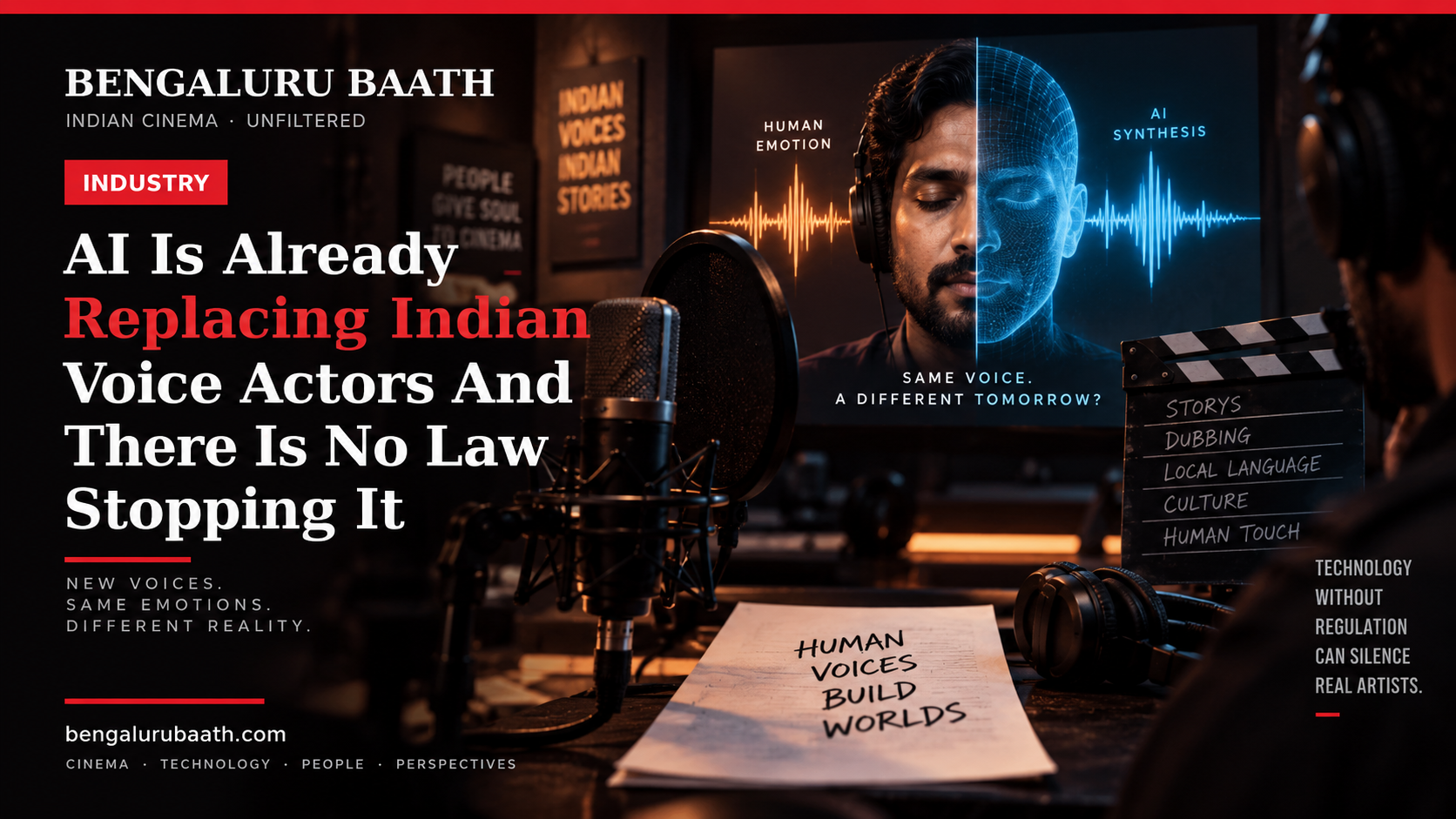
Image status: NO_REUSABLE_PHOTO_FOUND / ORIGINAL_BB_CARD_CREATED
Image source: Original artwork generated by Bengaluru Baath
Image file: 022_AI_Is_Already_Replacing_Indian_Voice_Actors_And_There_Is_No_Law_Stopping_It.jpg
Photographer / copyright holder: Bengaluru Baath (original graphic)
Licence / usage: Original work owned by Bengaluru Baath. Free to publish, modify and syndicate.
Date created / downloaded: 2026-09-20
Photo-sourcing note: No third-party photograph could be licensed: this newsroom session’s network policy blocks Wikimedia Commons, Unsplash and Pexels, so no licence could be verified first-hand. Per Bengaluru Baath policy no copyrighted press photo was downloaded. An original BB featured card was generated instead. See image_sourcing_queue.csv for the exact photo brief.