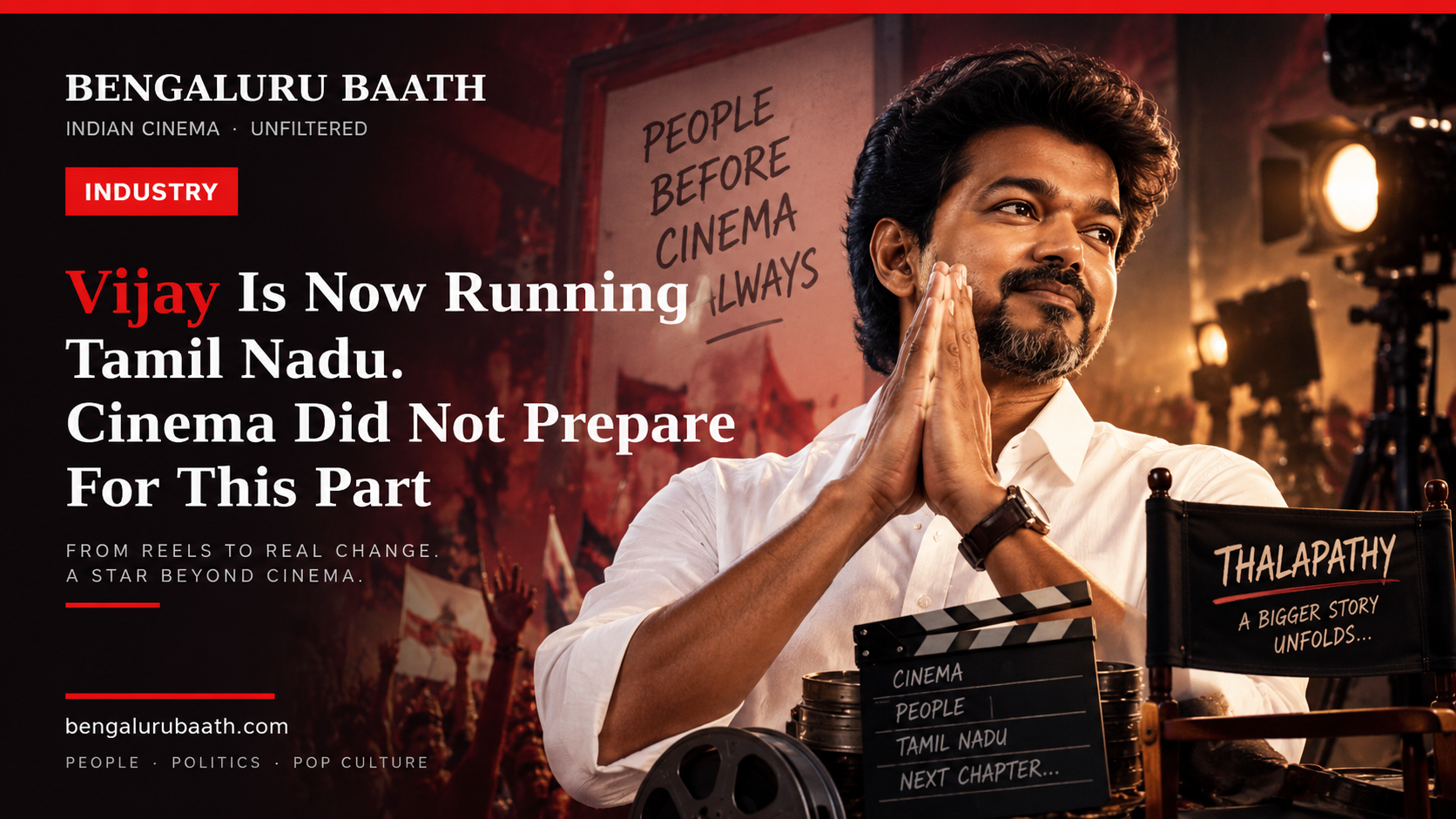
Tamil Nadu has been writing this script for seventy years. MGR did it. Jayalalithaa did it. Every few election cycles a star announces a party, the state holds its breath, and usually nothing much happens.
This time something happened. Vijay is the Chief Minister of Tamil Nadu.
Variety reported the sequence in two parts. First: after the 2026 Tamil Nadu Legislative Assembly election, Vijay staked a claim to form the government following what the trade called a historic win for his party, Tamilaga Vettri Kazhagam. Then, after what Variety described as days of high drama, he was sworn in as Chief Minister.
Britannica’s entry on him now carries the Chief Minister line alongside the filmography, which is a small detail that tells you how completely the frame has shifted. For most of three decades the defining fact about this man was that he was Thalapathy. Now it is a constitutional office.
The cinema side of this is messy in a way nobody has fully resolved. Jana Nayagan was announced and marketed as his final film. It was postponed, with the makers citing unavoidable reasons, per Gulf News. It sits there, finished or near finished, attached to a man who now has a day job that makes a film release a political event rather than a commercial one.
Tamil Nadu is the only place in India where the film-to-politics pipeline is not a novelty but a tradition with a functioning grammar. C.N. Annadurai wrote screenplays. M. Karunanidhi wrote dialogue. MGR built an on-screen persona of the protector of the poor and then converted it into a mass political base. Jayalalithaa followed.
That pipeline had been dry for a long time. Rajinikanth teased a political entry for the better part of two decades and eventually stepped back. Kamal Haasan started a party and found that critical respect does not convert into votes at the scale required.
Vijay’s move was different in one specific way: he stopped acting first. He announced the exit from cinema, built TVK, and campaigned as a full-time politician rather than a star doing politics on weekends. Al Jazeera’s pre-election coverage framed the central question bluntly, asking whether another film star could actually sway a Tamil Nadu election. The answer turned out to be yes.
Confirmed: TVK performed strongly enough in the 2026 Tamil Nadu assembly election for Vijay to stake a claim to government formation, and he was subsequently sworn in as Chief Minister. Jana Nayagan was positioned as his final film and has been postponed, with the producers citing unavoidable reasons.
Not confirmed, and treated as open: a new release date for Jana Nayagan, whether he will ever appear on screen again, and what happens to the projects and commitments that were built around his star value.
Start with the money. A Vijay film was one of a handful of Indian releases that could be pre-sold internationally on the name alone. Distributors, satellite buyers and streamers all budgeted around a Vijay slot in the calendar. That slot is now gone, and it is not obvious who fills it. Tamil cinema has genuine stars, but it does not have a spare one of that scale sitting idle.
Then the softer thing. Tamil political cinema has always been able to gesture at power from outside it. The hero fights the system, the audience cheers, everyone goes home. It is much harder to write that film when the man who used to play the hero is the system.
And there is a watching-brief for the rest of the country. If this works, expect the calculation to be run again in Telugu, in Kannada, in Bengali. Every industry has a star with a fan network that looks a lot like a party cadre. Tamil Nadu just demonstrated the conversion rate is not zero.
A note on what a film star actually brings to electoral politics, because it is frequently misunderstood. It is not the popularity. Plenty of popular people lose elections. It is the distribution network: fan clubs that already exist at the ward level, that already collect money, organise events and mobilise crowds, and that can be converted into booth-level organisation faster than any new party could build from scratch.
That is the mechanism, and it is also the limit. The Himal Southasian analysis of this election argues that stardom has ceilings in Tamil politics, and that the Dravidian parties’ machinery is not a thing you out-glamour.
The honest position right now is that a very unusual thing happened, and the interesting questions come next: governing is a different job, and unlike a film, you cannot recut it after the first weekend.
BENGALURU BAATH TAKE
We have watched Tamil Nadu tease this storyline our entire lives, so forgive us for being a little stunned that it actually resolved. The cinema question fascinates us more than the political one. Vijay did not fade out, he did not do the elder-statesman character arc, he walked off mid-career with a finished film sitting in a vault. Tamil cinema now has a hole in its release calendar and a star-shaped absence in its economics, and the industries watching from Hyderabad and Bengaluru are quietly running the same numbers. Whatever you think of the politics, this is the single most consequential thing to happen to South Indian film business this decade.